FIS Global
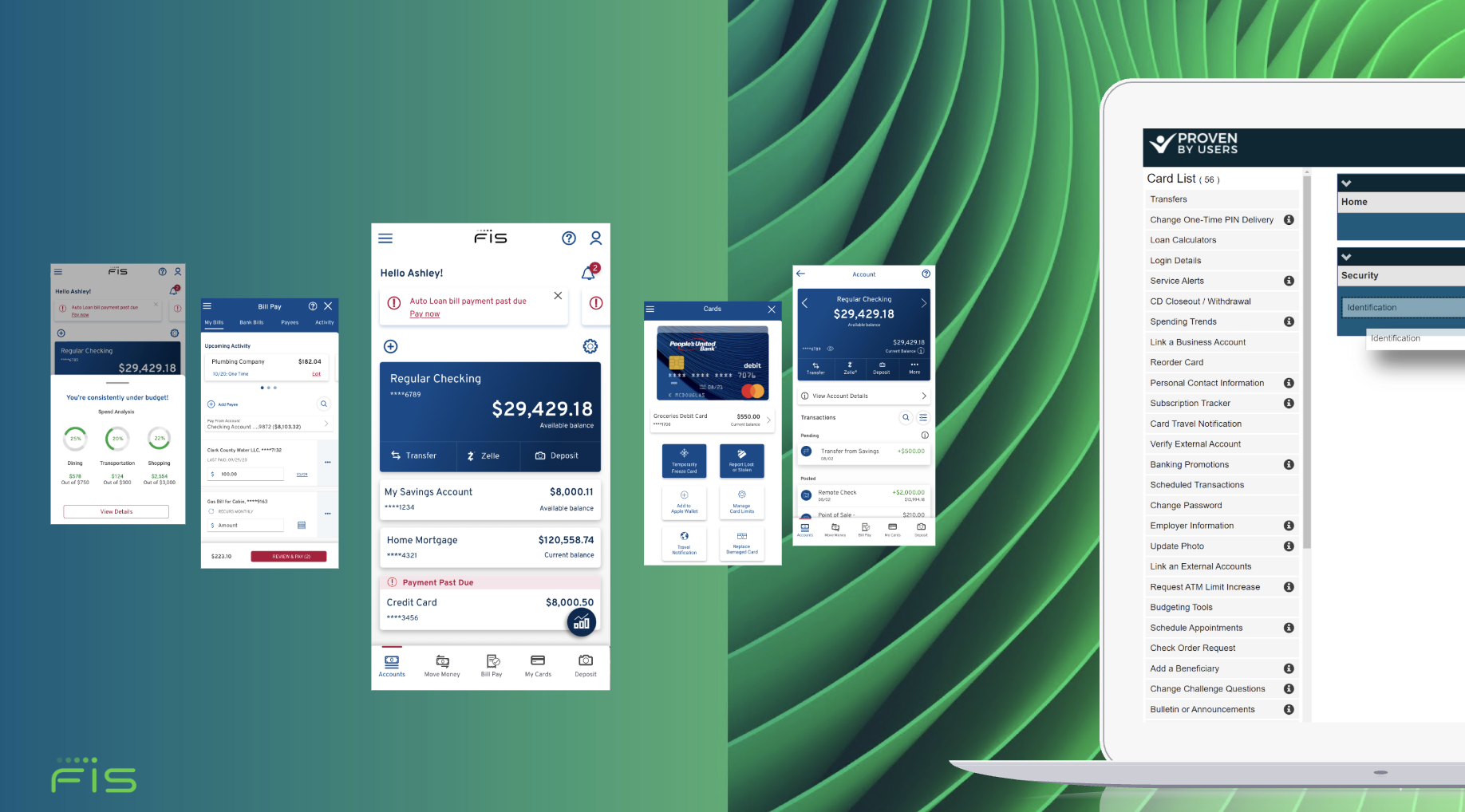
FIS, a global leader in financial technology, provided both a core banking platforms and a configurable digital front-end to financial institutions to power their customer experiences. While most clients adopted a standard front-end, one partner institution wanted leap ahead with a fully upgraded digital experience. They approached FIS with an ambitious proposal: co-invest in the development of a next-gen platform tailored specifically to their needs, while allowing FIS to later harvest the experience for future clients.
The initiative—internally referred to as the Digital Banking Accelerator—moved quickly. Our client wanted to launch a significantly redesigned experience on an aggressive timeline, requiring rapid discovery, iteration, and validation across critical journeys such as onboarding and account servicing.
My Role
As the sole researcher, I was responsible for establishing the research foundation and guiding the design process under tight time constraints. Over the course of approximately 6 months, I analyzed competitive and market intelligence, synthesized existing research, evaluated the platform’s navigation, and partnered closely with design through iterative concept validation. As the new experience took shape, I conducted a series of usability studies to refine onboarding flows and key account management capabilities before launch.
The project ultimately resulted in the successful launch of a modernized digital banking platform for our client. At the same time, the research generated valuable insights into customer needs and behaviors that helped FIS evolve persona segments, sales positioning, its front-end offerings for additional clients.
Organizational Scope
CX Leadership Team
Drew Hopkins — Lead of Research
Dean Valentin — Lead of Design
Kim Busch - Creative
Tracey Dunlap — Lead of UX
Tools
UserTesting, SurveyMonkey, ProvenByUsers, AdobeXD
Competitor Research
To ground the redesign in industry trends, I researched direct and indirect competitors. I created an excel database within which I could compare proportions of feature usage, navigation structure, and component choices across major competitors and look for trends between them. I created visual catalogs of user journeys looking for similarities and innovations among competitors.
This research reinforced designs with the most innovative practices on the market. Competitor research justified the simplification of disclosures and login as this practice was strongly embraced by neo-bank competitors. It also motivated a major navigational change favoring submenus over sequencing.
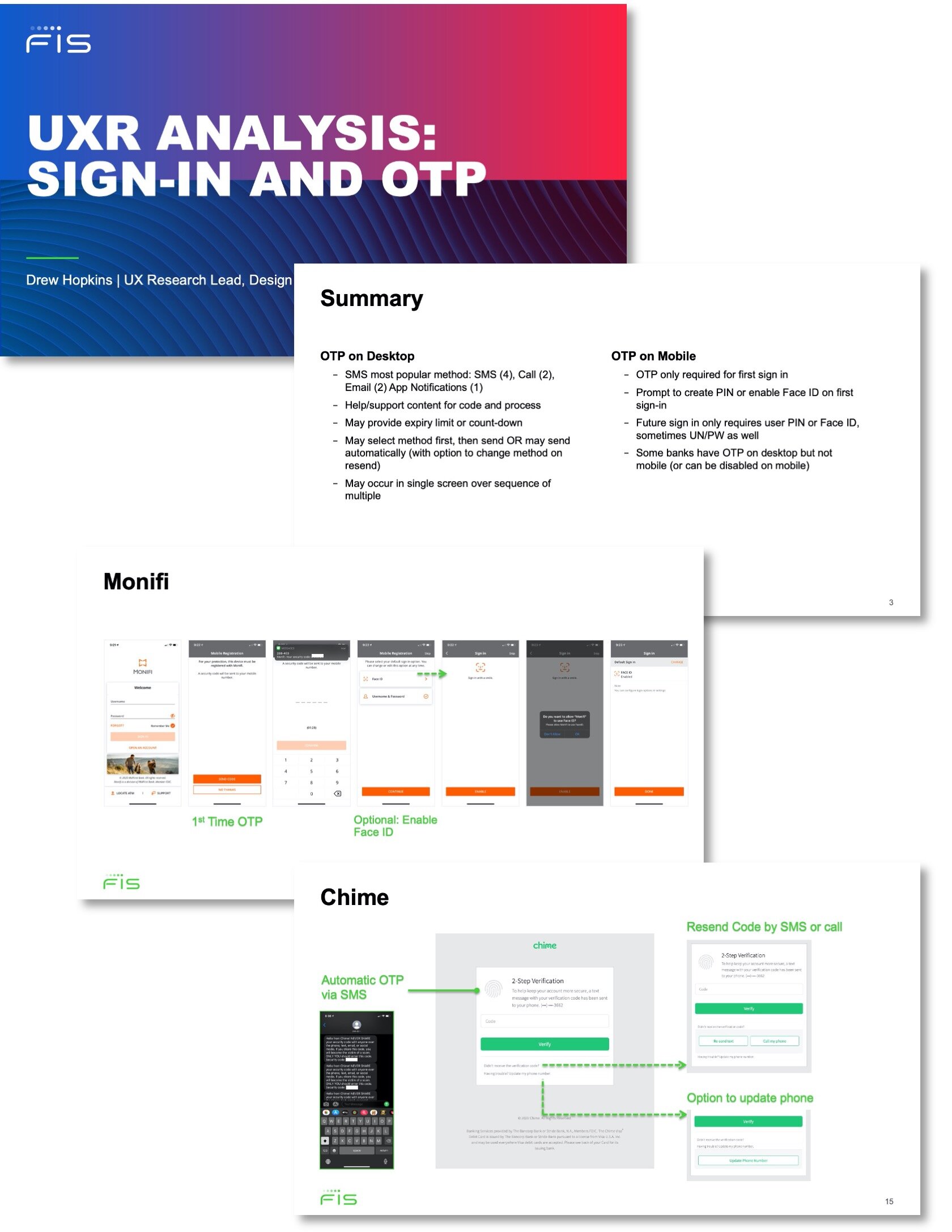
Sample of the UXR catalog on the Login Journey. This drove simplification of the Login sequence.
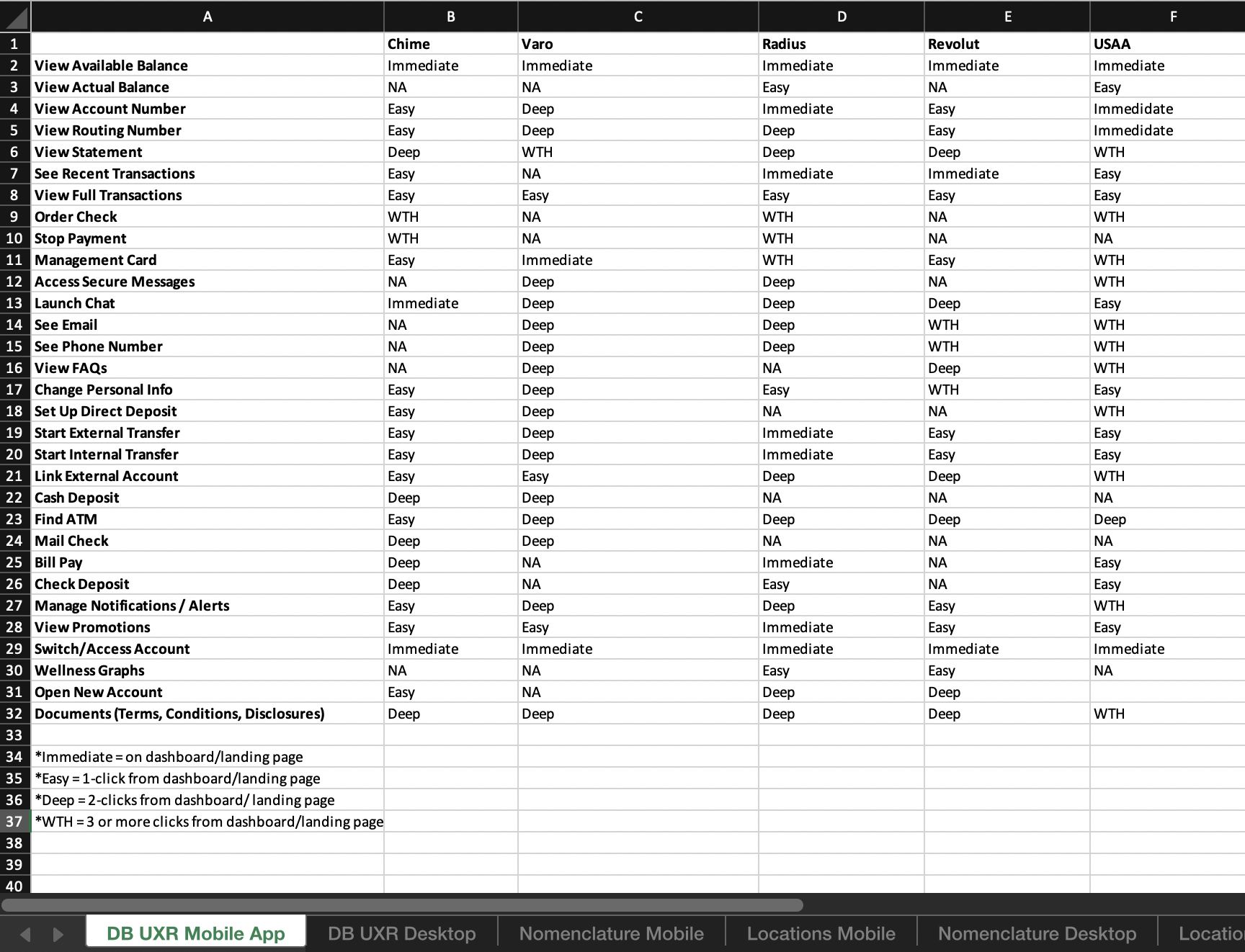
Sample form the UXR database. Features are rated on navigational depth across banking platforms and analyzed for trends.
Card Sort
Solid information architecture was essential for the foundation of a redesign and we knew navigation posed friction in account servicing from previous research. I launched a closed card sort of 10 categories that mapped to our current system. The results would set the foundation for any major design reconfigurations.
For this case study, let’s look at the results of the Security category. The results of the card sort suggested that Settings and Security were ambiguous for many. Participants had no strong consensus on which cards to put in Security. The cards they did put there weren’t consistent with our sitemap.
In observing the bonds and clustering between the cards agnostic of their categories, I realized that Security related cards had a strong correlation with Settings related cards. Security was not perceived as a valid category, but participants thought of these cards as Settings-items. I proposed we scratch the Security category all-together and relocate it’s content within submenu inside Settings. I also recommended we extract alerts out of Security as their own navigation component — this was supported by the clustering and what I found elsewhere in competitive research.
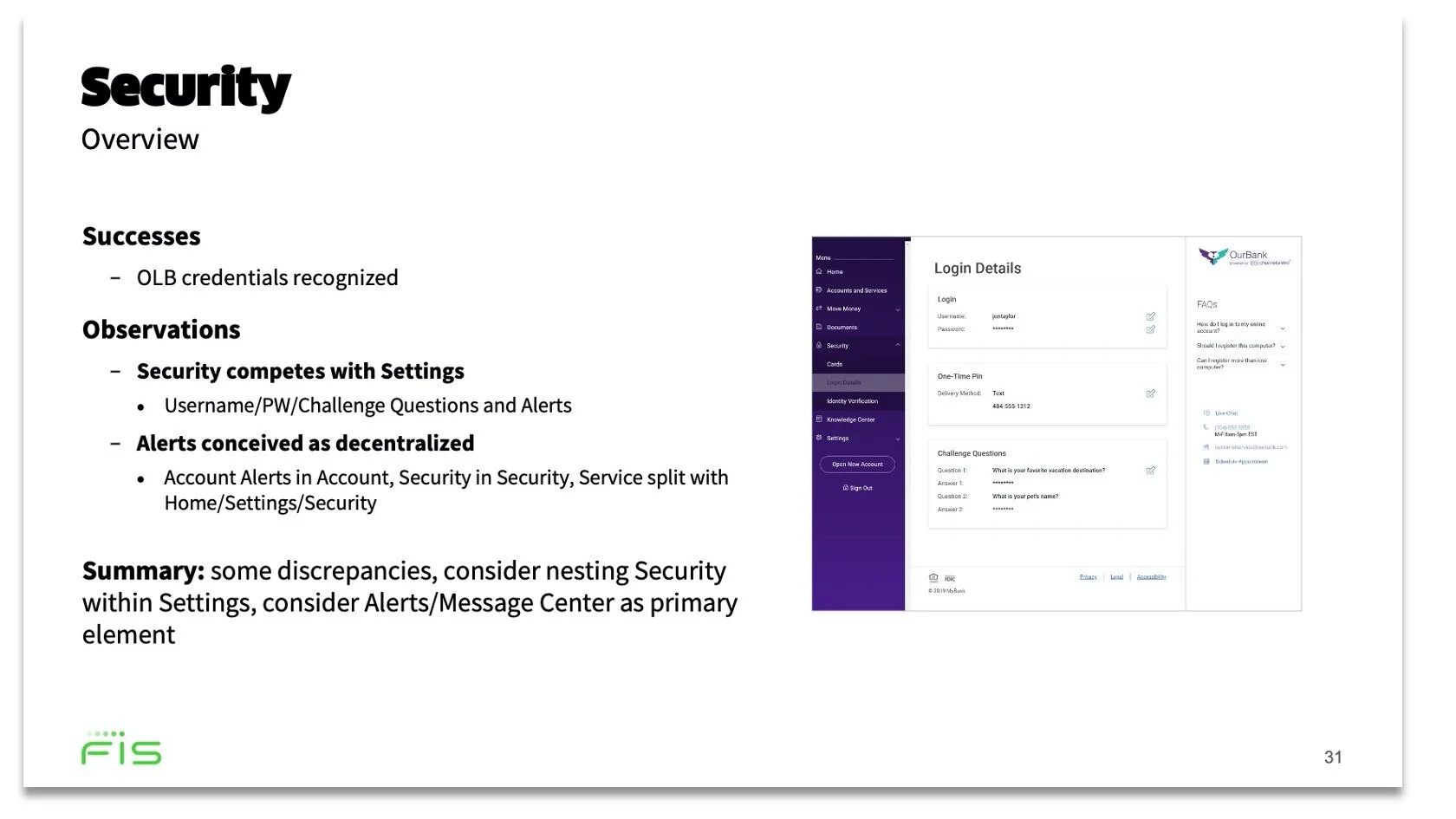
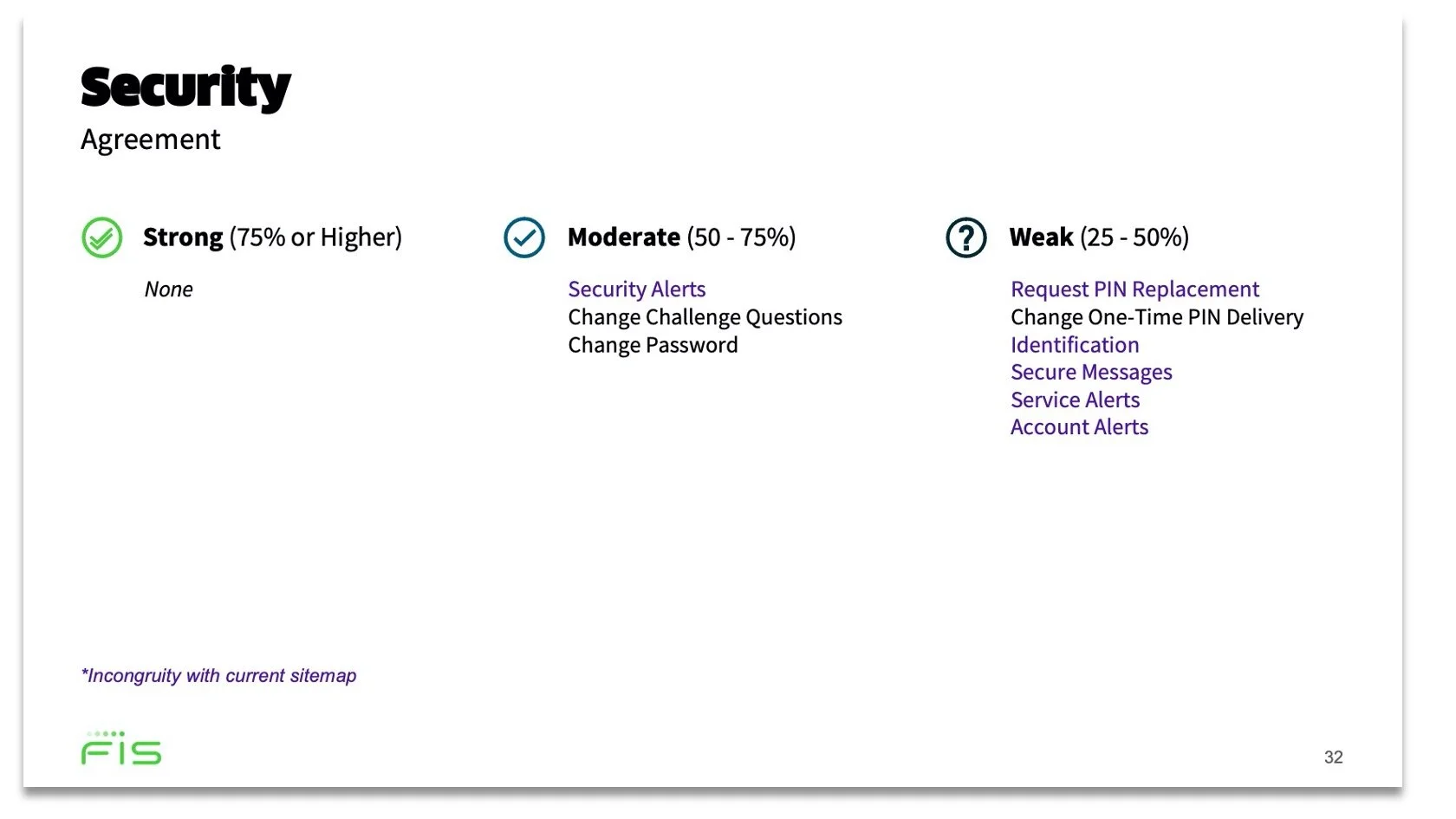
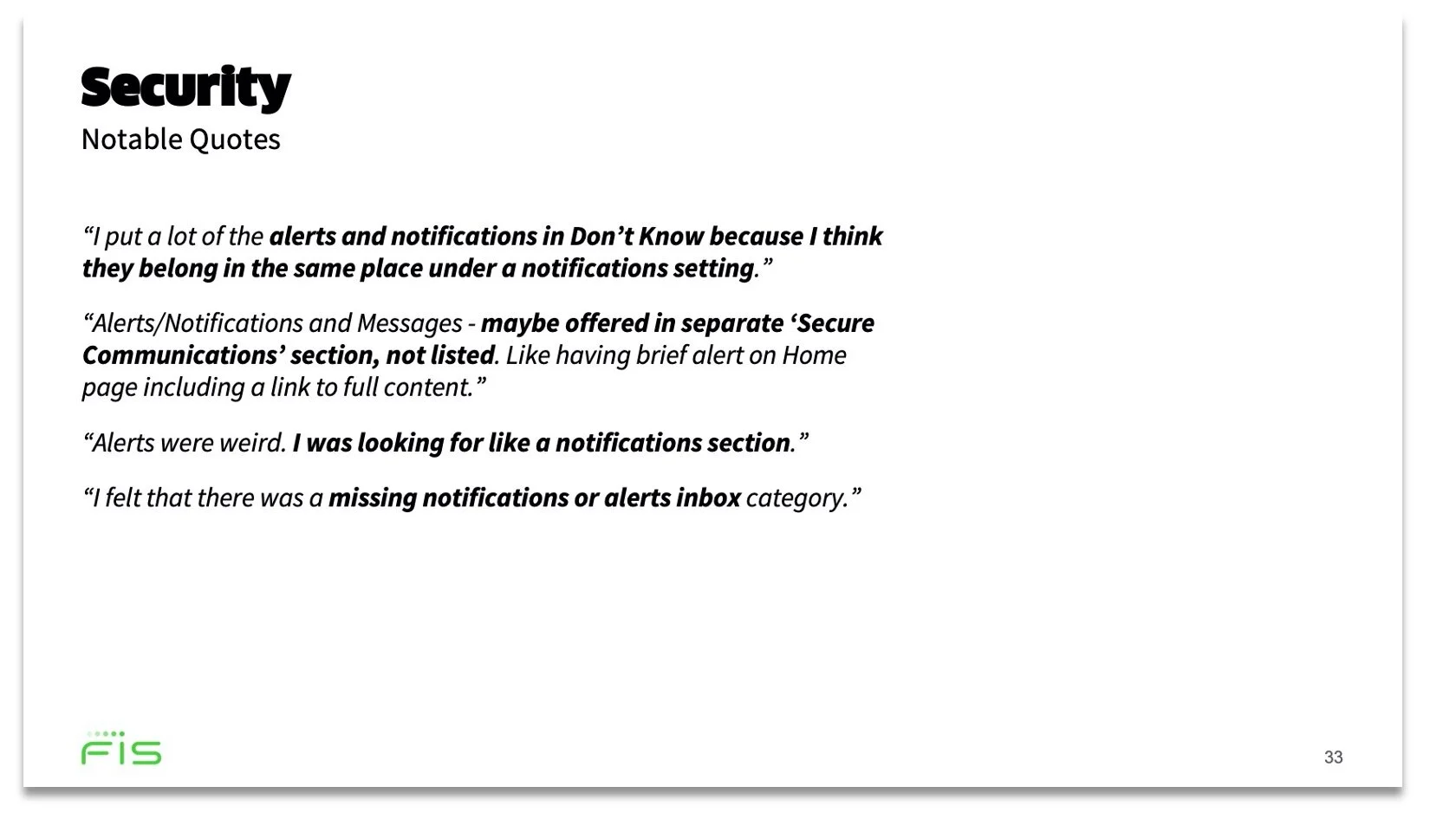
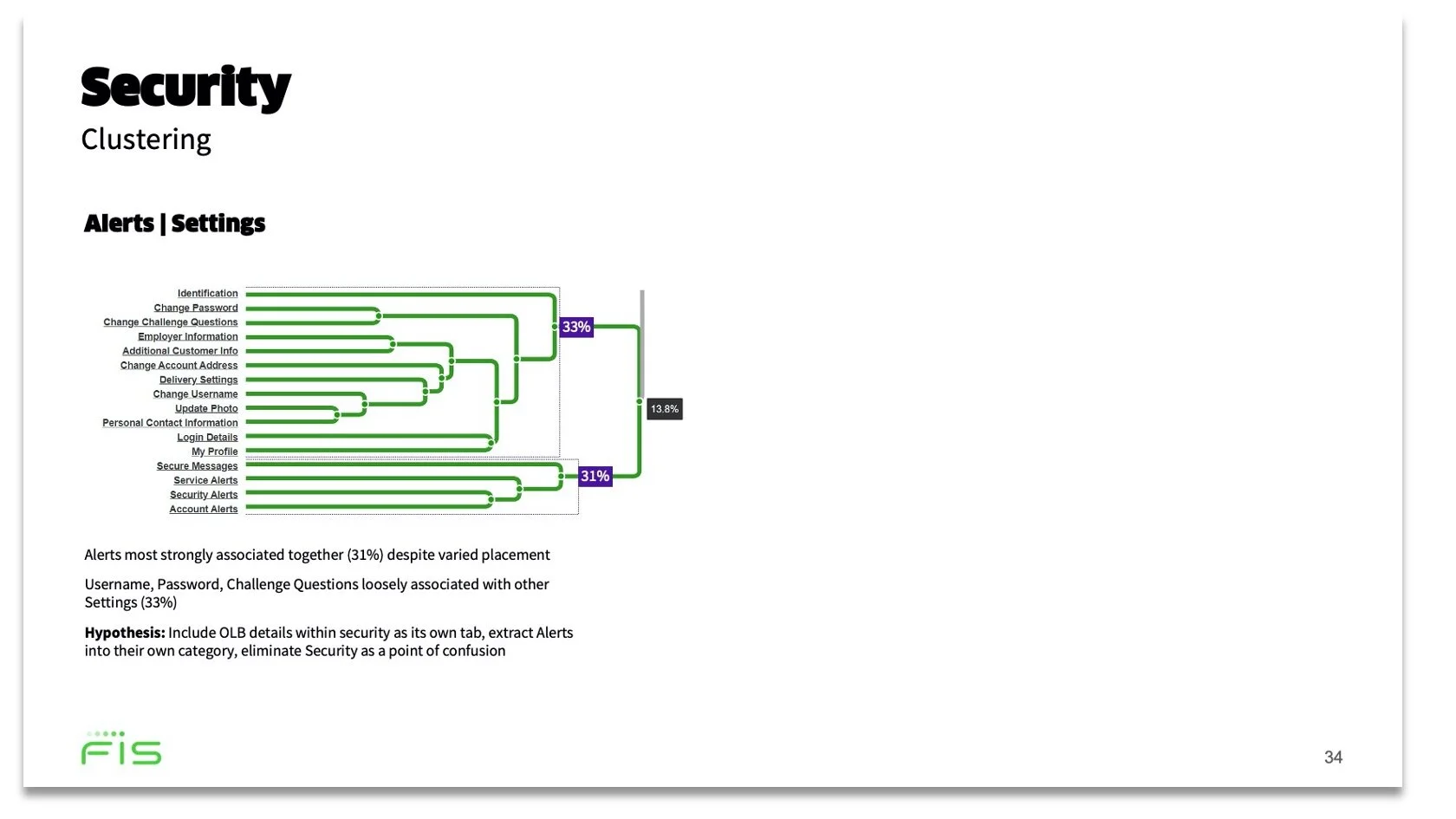
Excerpts from my analytic summary of the card sort results. Security was reimagined as Settings and Alerts.
Polls and Preference Tests
With competitive research and navigation testing married up with design team’s modern vision, the team saw potential improvements. The design iterated on concepts and I informed new directions with polls and preference tests. We tested aesthetics, component variations, and navigational pathways this way. We also iterated on several variations of the dashboard in particular.
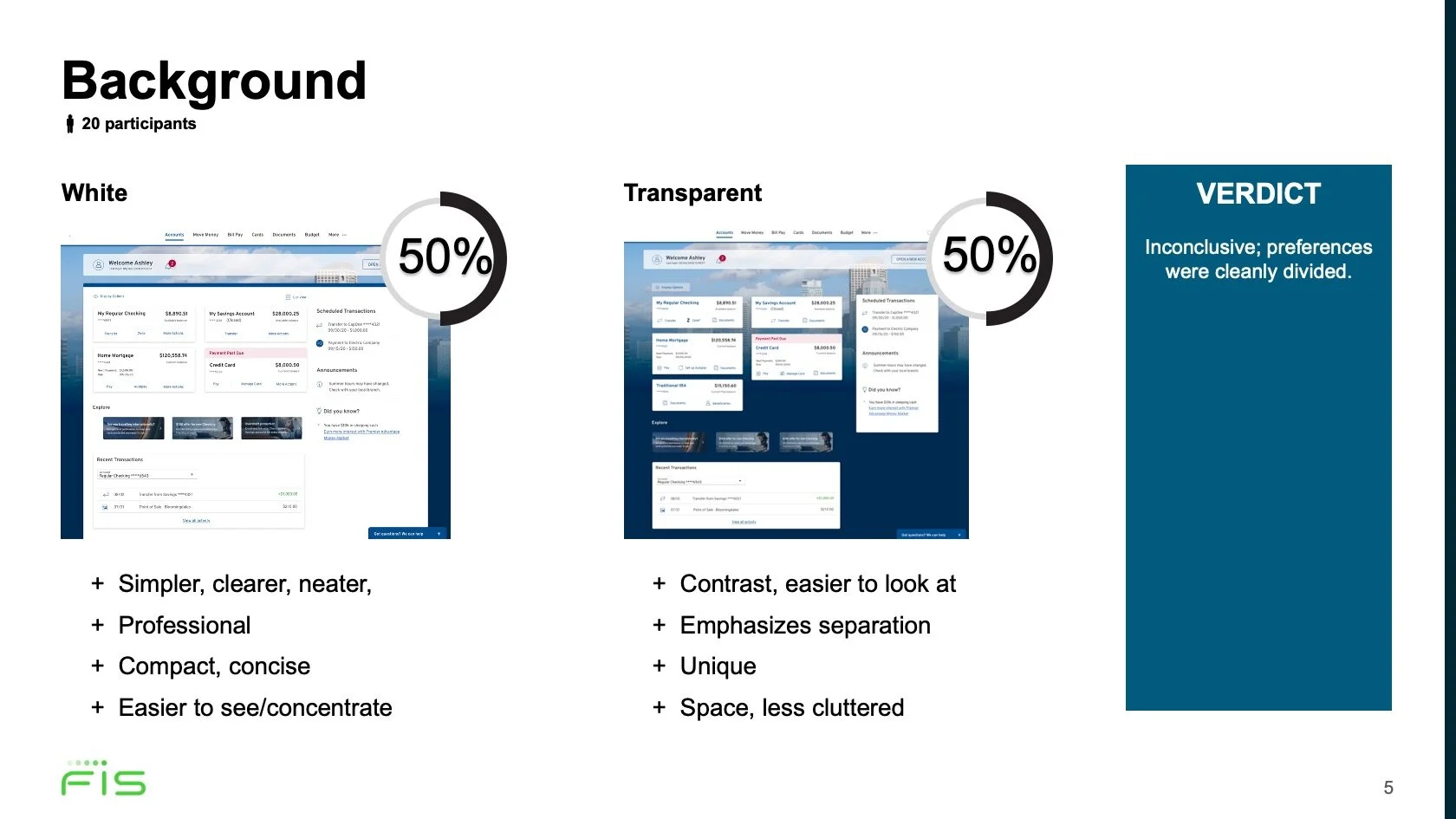

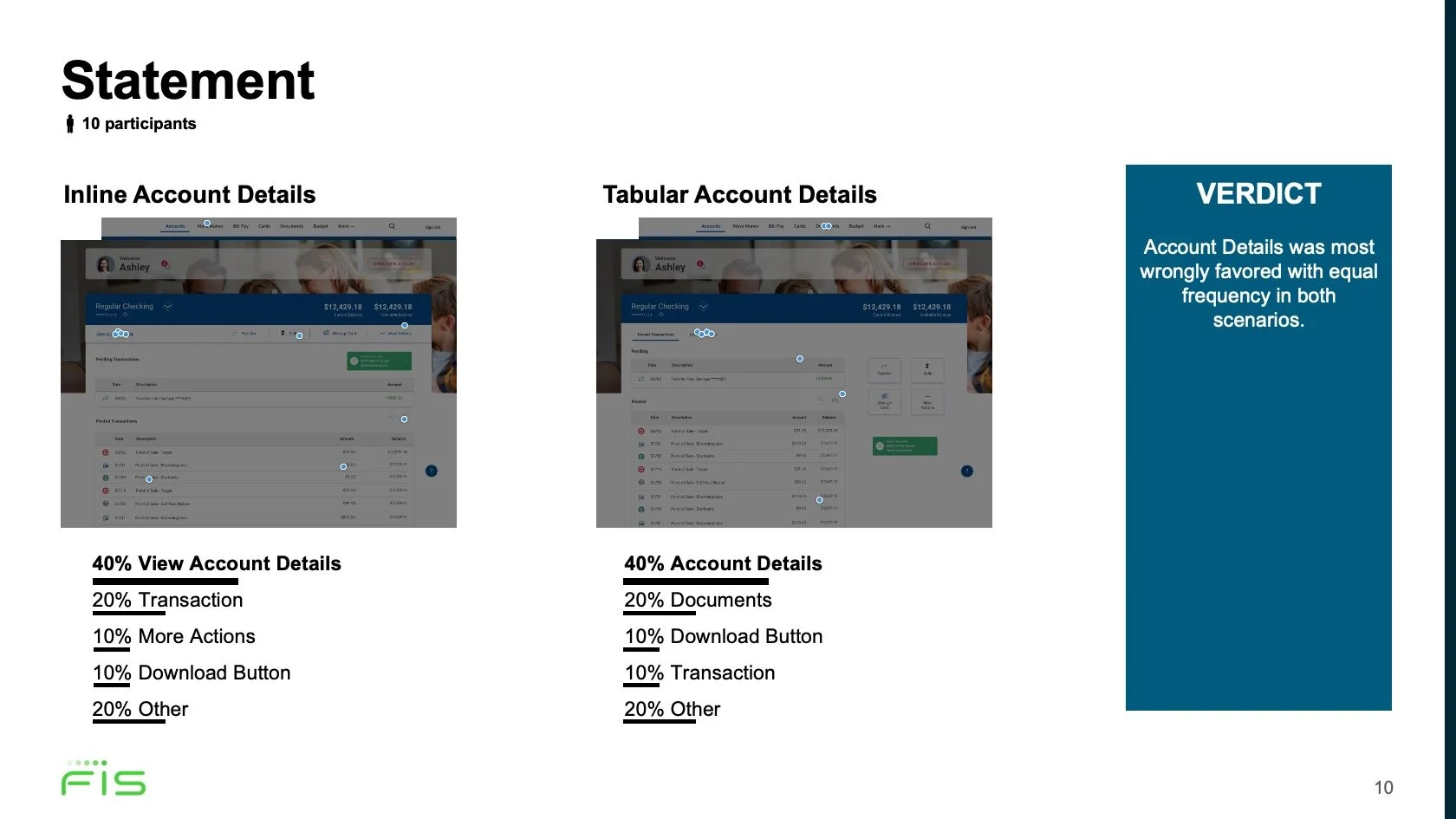
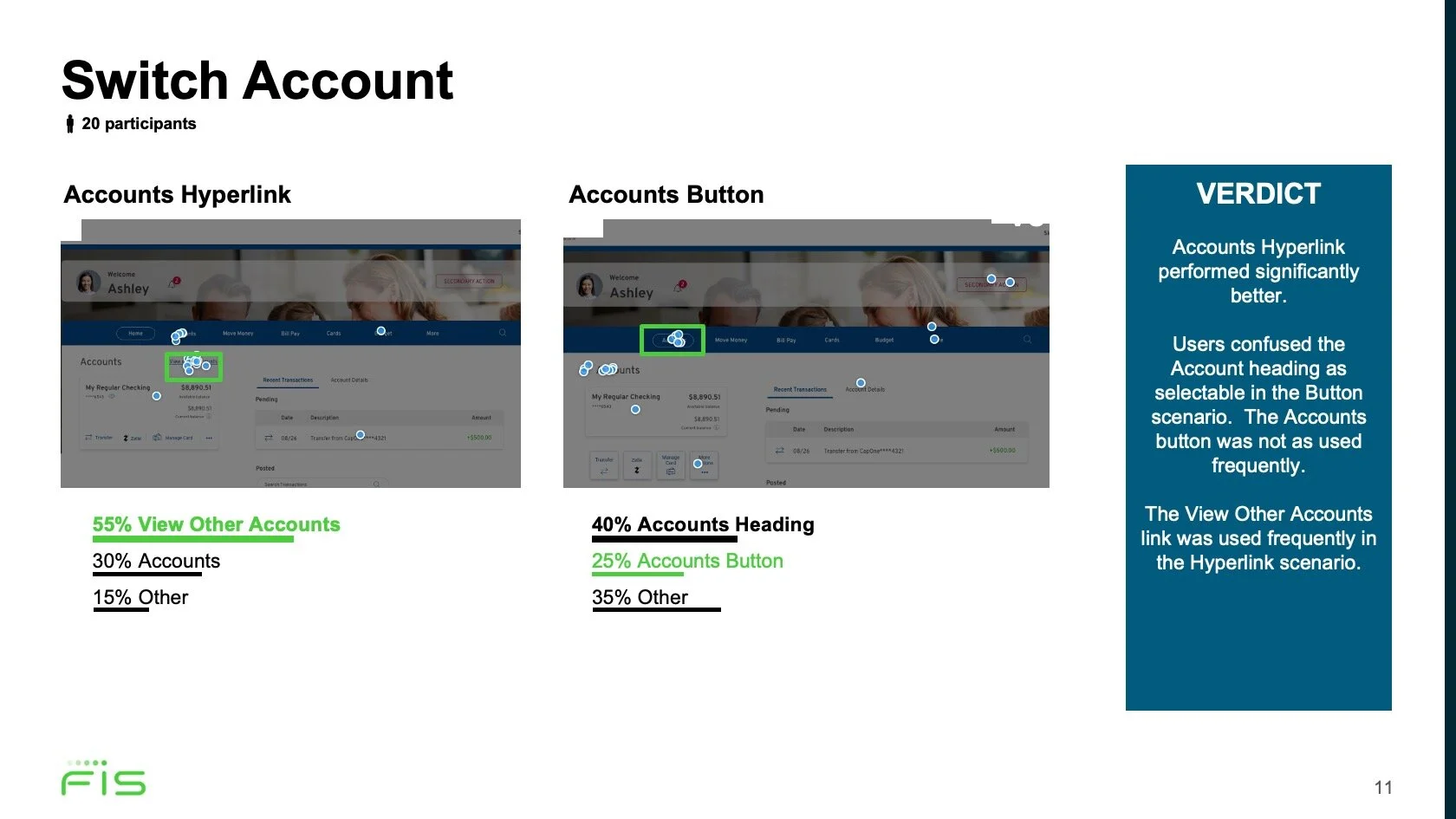

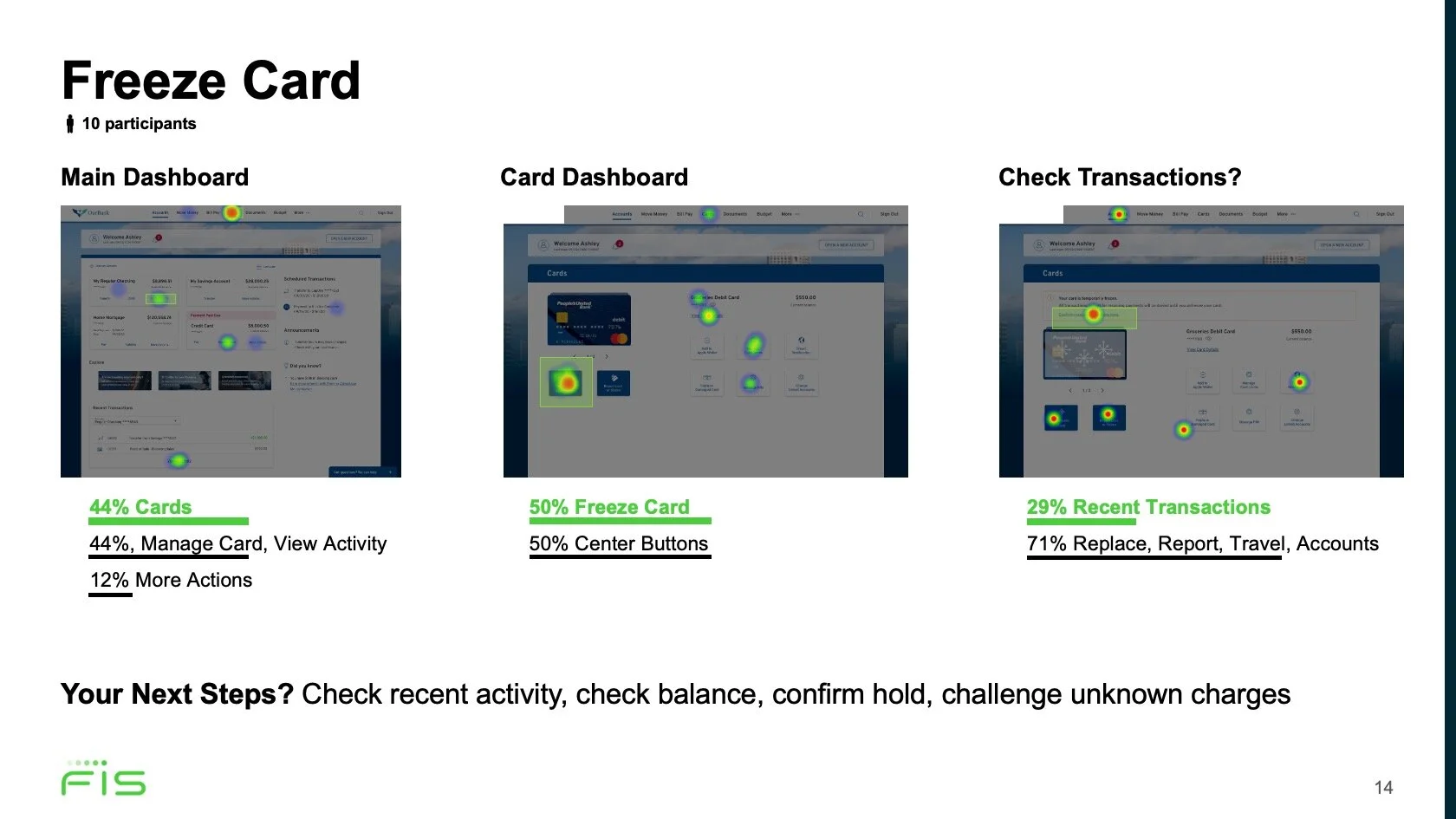
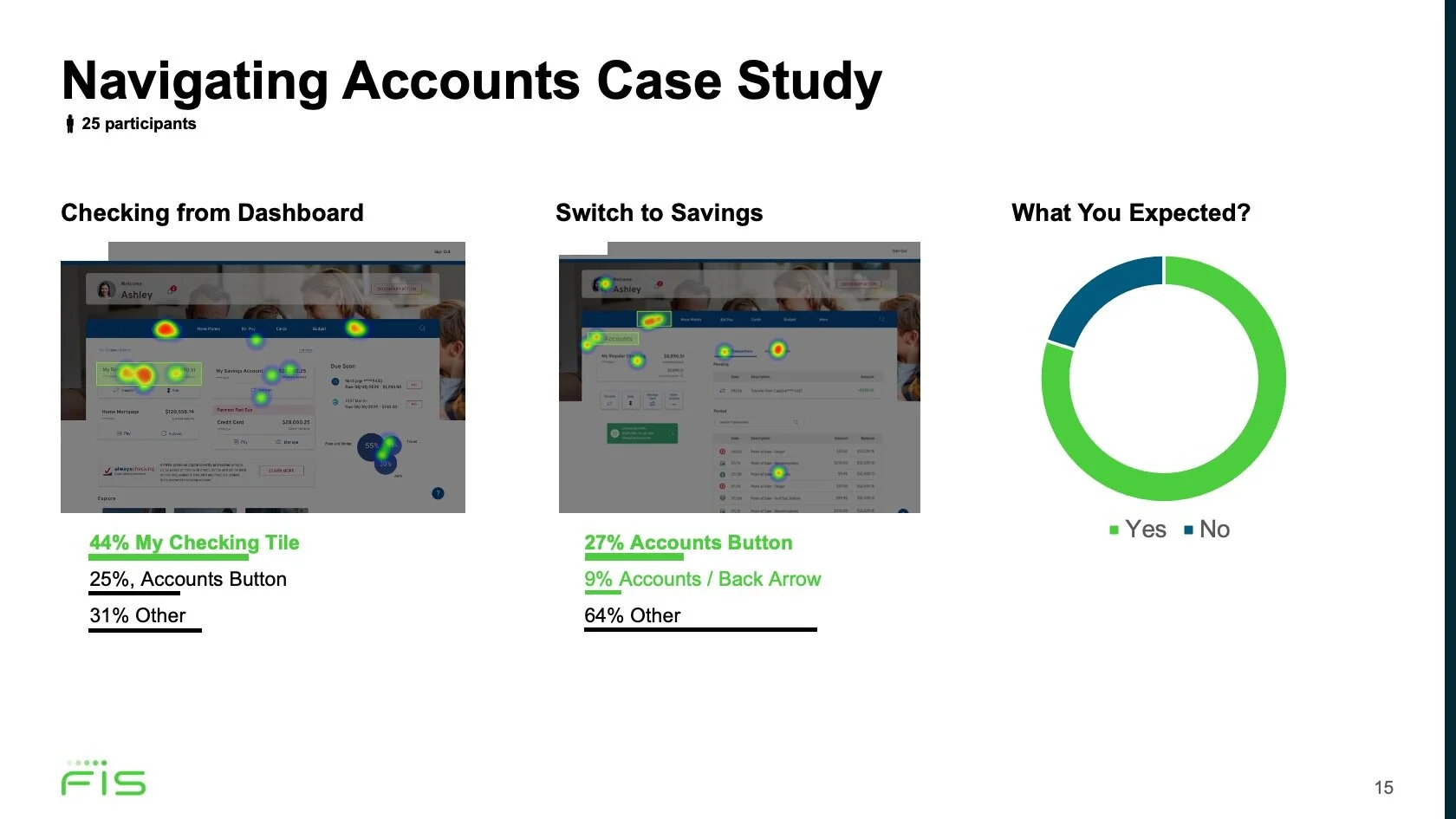
Sample of my analytics that drove some of the design’s larger refinements.
Research Boards
Usability was the heaviest focus of the redesign as our client (as with many banks) was risk-averse and conservative. Testing was an opportunity to include our client’s observations and feedback throughout our studies. There were high-stakes to present and execute this stage with polish.
Since the designs were being shared through Miro, we would house our in-sprint research findings there as well. I developed a systematized Miro research boards to collect, analyze, and share our data — for each user journey, there was a board to grade issues on a severity-scale and provide stats and video clips. Our clients could also leave suggestions and questions so that we could address their concerns in real-time.
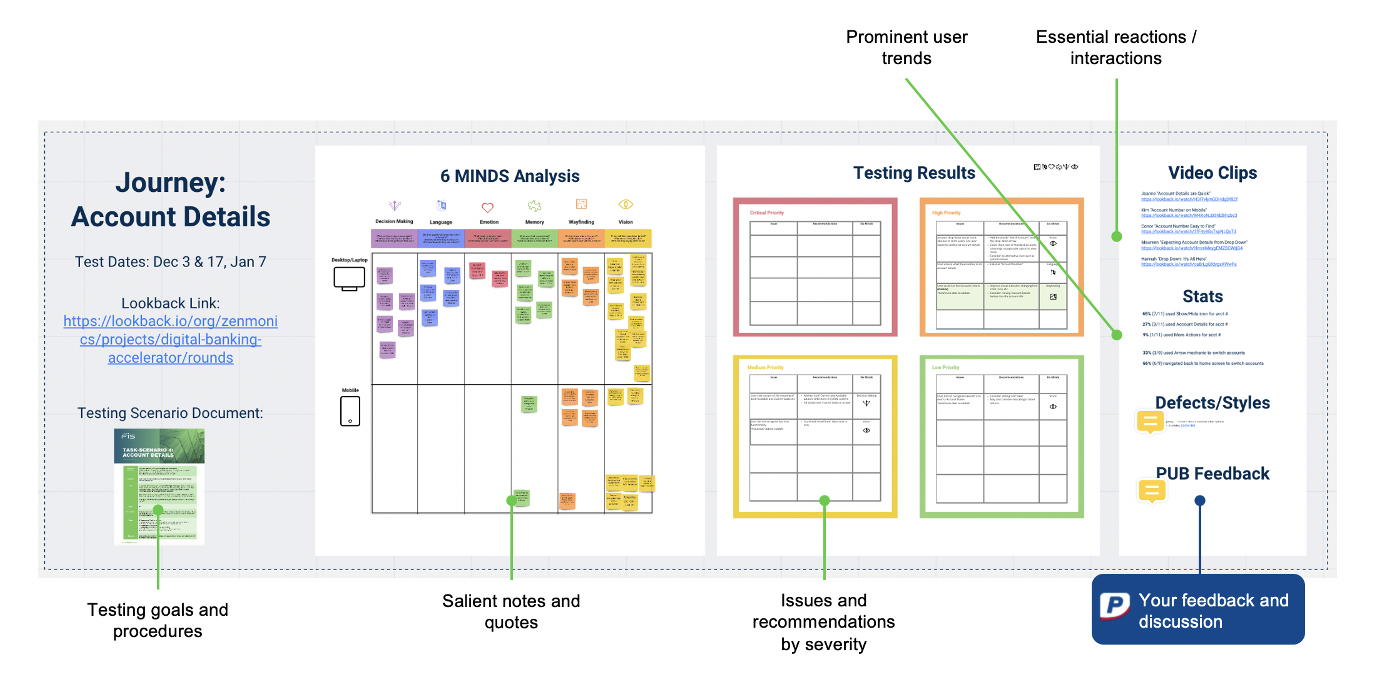
Sample board for the Account Details journey.
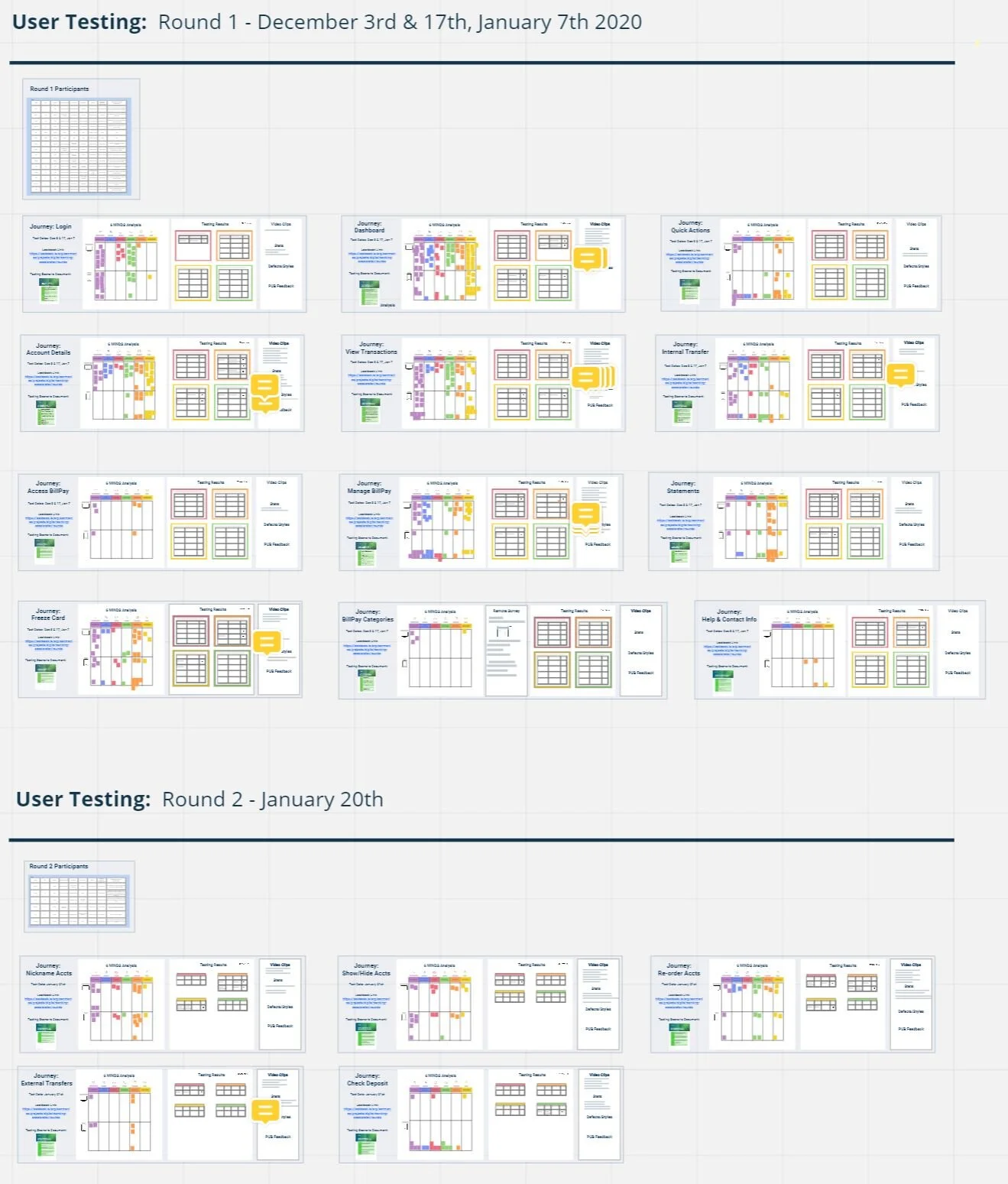
Overview of the first two sprints. Analysis, severity ratings, stats, and clips.
Task-Scenarios
I evaluated the designs for each of our target use cases. I imagined the user’s context, determined needs and motivations, and identified the greatest potential weaknesses of our prototype. With this in mind, I developed scenarios for the user journeys and crafted actionable tasks that would test hypotheses. I noted my assumptions and identified the happy-path steps that would lead to our success criteria. I then refined the prototypes and testing strategy with the designers.
These “task-scenarios” would serve as our moderator scripts during testing, but would also record our hypotheses and rationales for reference as well as give the client visibility of our process. I templated the task-scenario strategy with an instructional for future researchers.
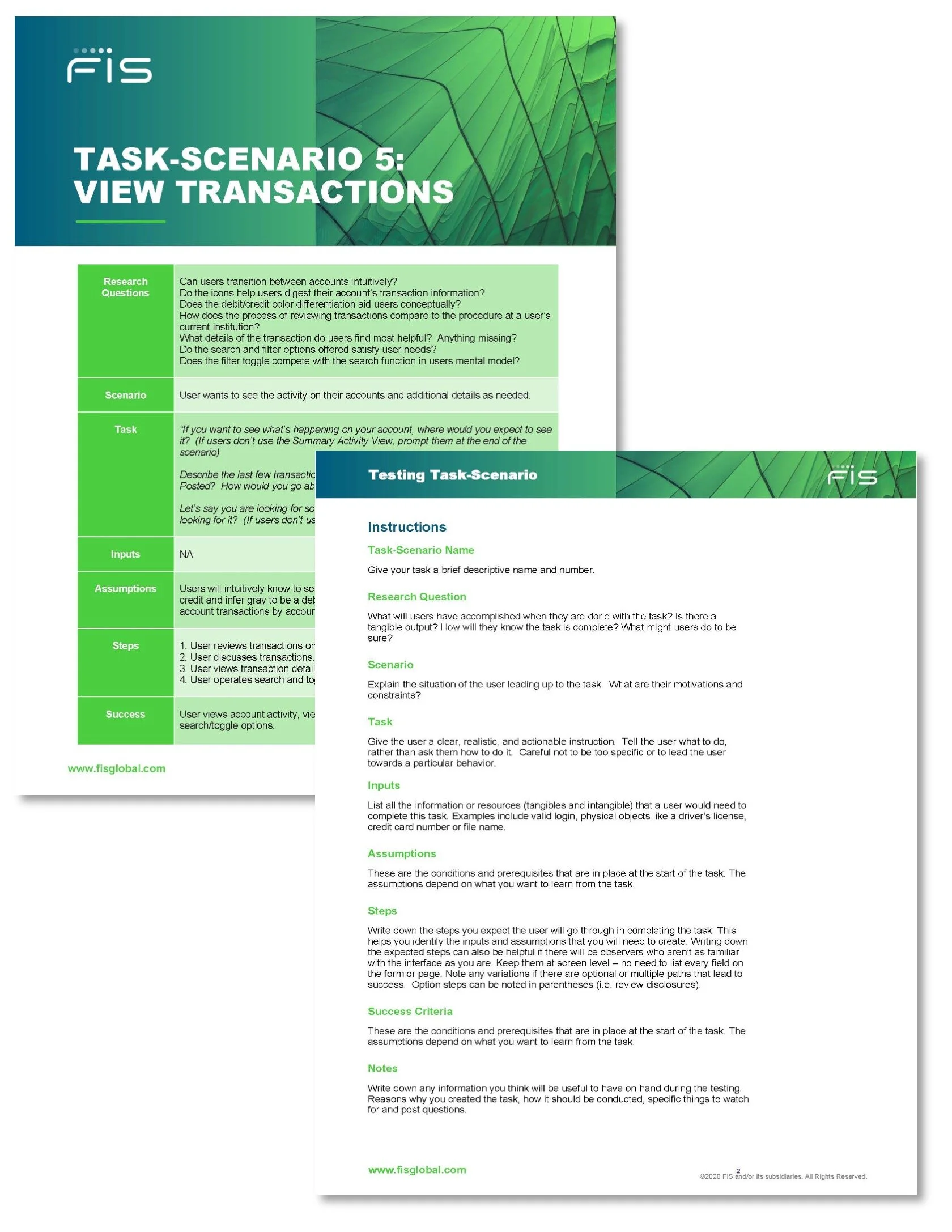
Sample Task-Scenario for the View Transactions journey. There were 28 journeys total.
Recruitment and On-boarding
We adjusted our digital banking screener to account for interest areas particular to the client and our testing:
Client membership
Account ownership
Branch Importance
BillPay usage and frequency
App dashboard usage and utility
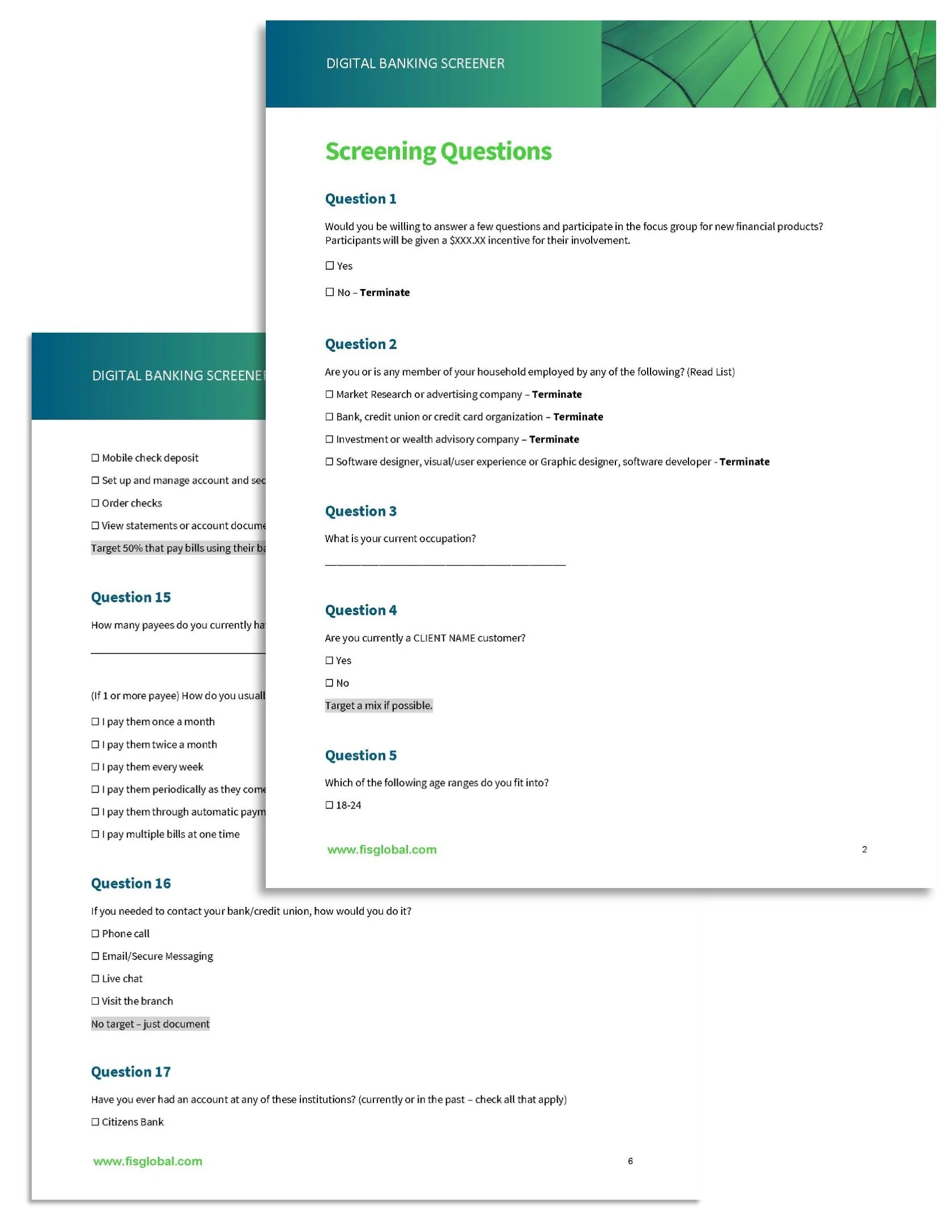
Excerpt from my survey/screener.
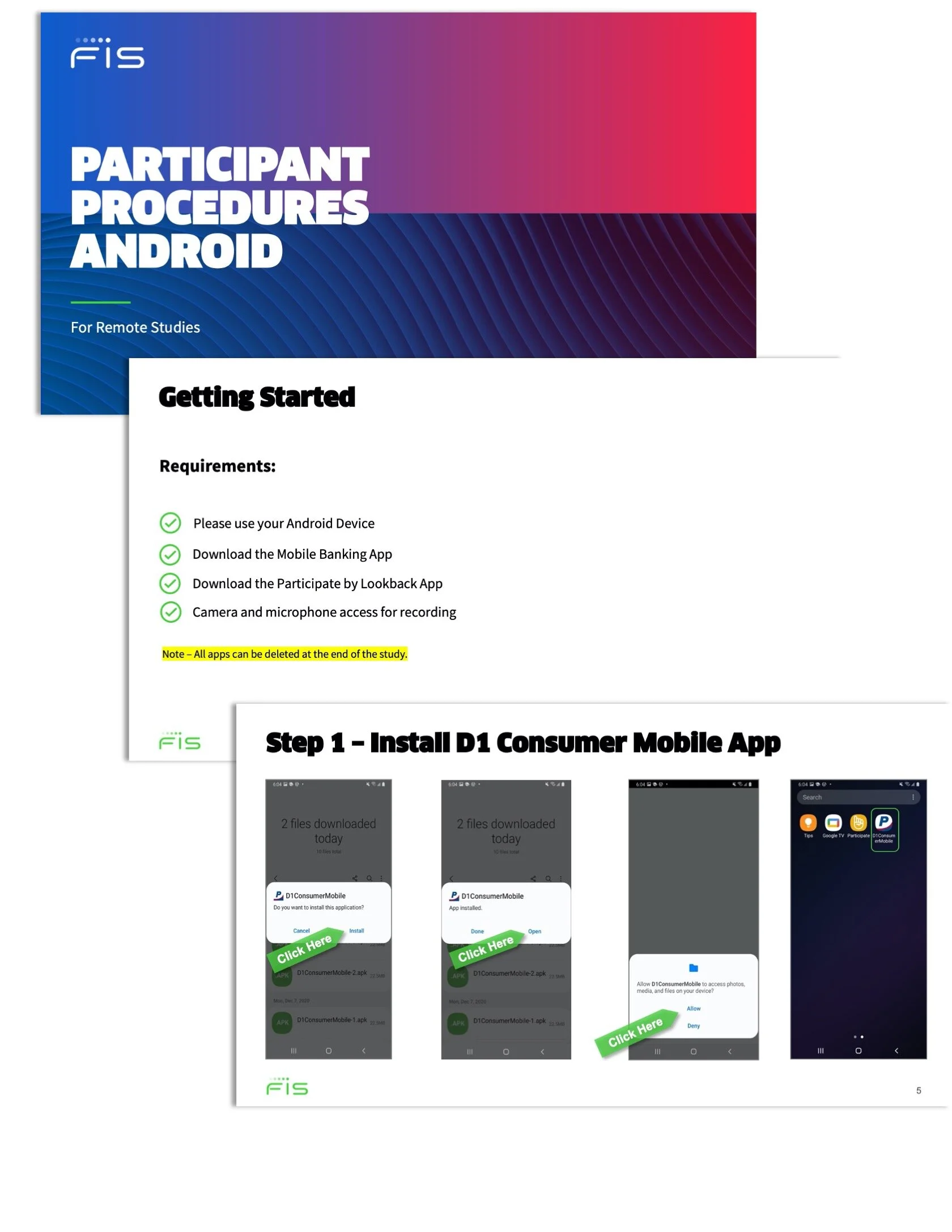
Excerpt from my participant on-boarding procedures.
Survey/Screener Analytics
I extracted the demographics and behavioral statistics from our survey/screener and examined them for trends. Our users were predominantly BoA, Chase, and CapitalOne users, a bias I would need to factor.
I was also able to gauge the importance of different financial activities and habits. The survey was great for gaining insight on dashboard needs and sensitivities.
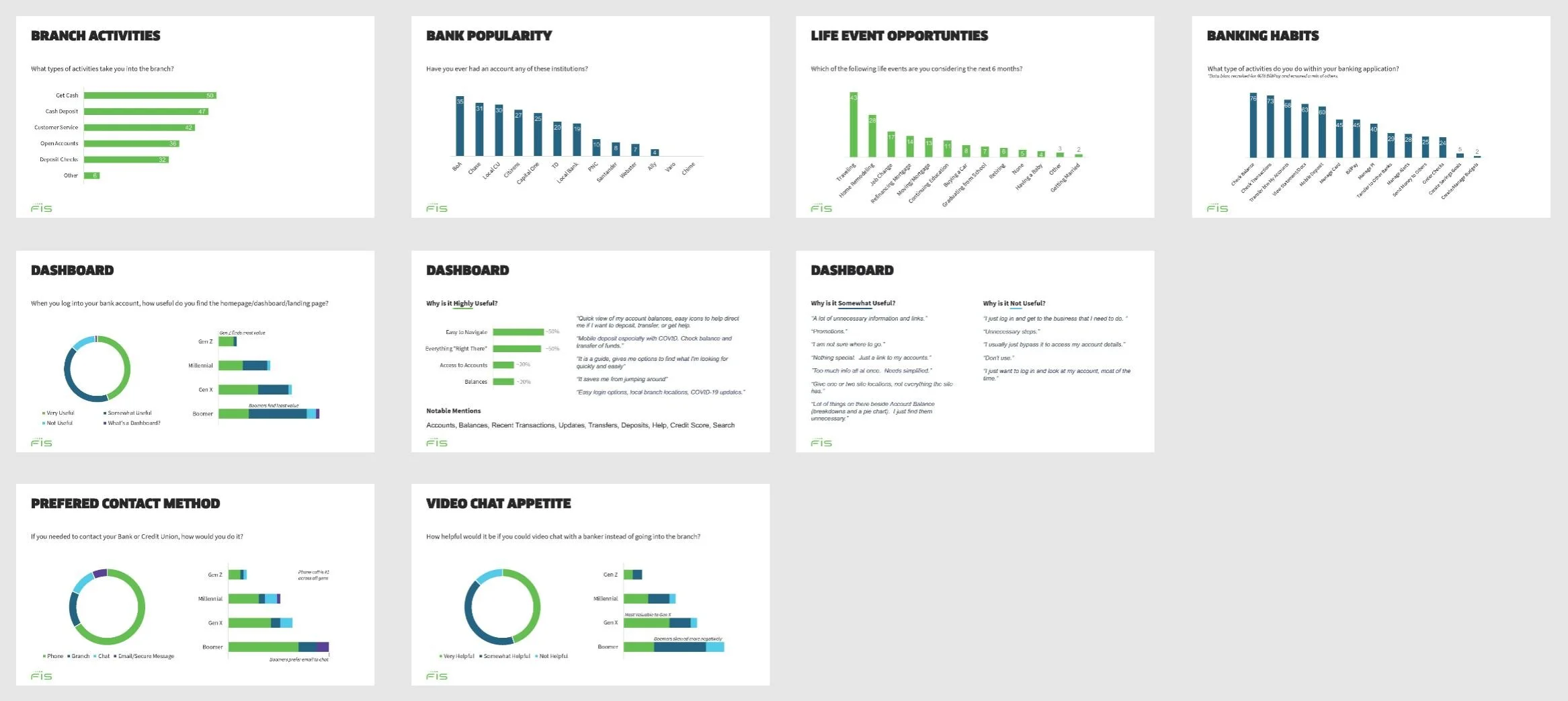
The screener is not just a filter, but can be used to gauge appetite, preferences, and habits as well.
Remote Usability Testing
I moderated tests in Lookback. We tested cross-platform (desktop/laptop/mobile) and device (iPhone/Android/etc.). Clients observed the sessions and could chat with us while we moderated in real-time.
We conducted 15-20 testing sessions per sprint and each session was 30-45 minutes long. For each session, we first conducted a “mini-interview”: we asked contextual questions to better understand the user journeys particular and explore opportunities.
The remainder of the session, we conducted a usability test using the task-scenarios relevant to their device. We formatted the scripts to facilitate open-ended conversations around user expectations and impressions.
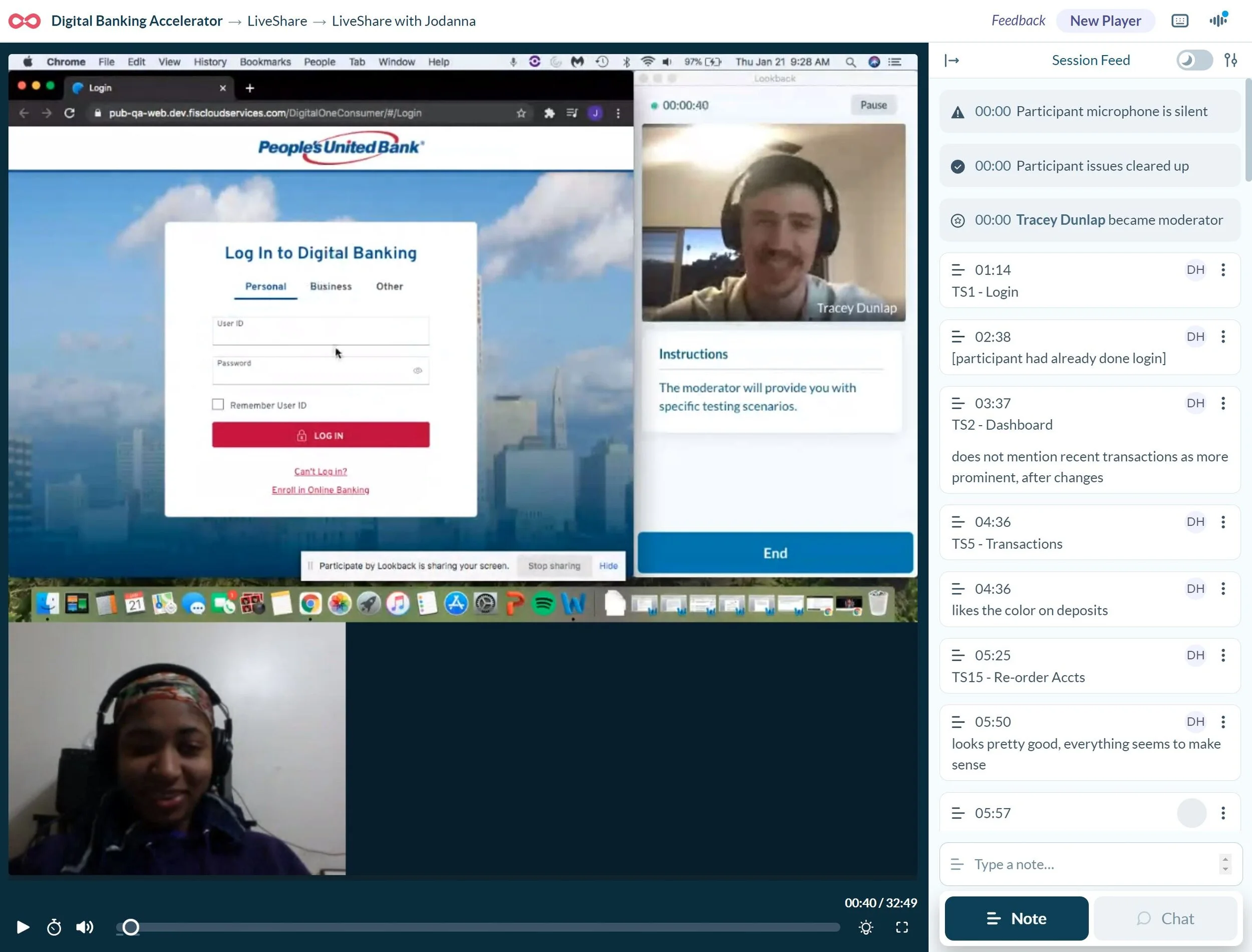
We moderated and recorded sessions in Lookback. For notes, I developed a system to flag our Task-Scenarios as well as other key metrics.
6 Minds Data Dissection
After each round of testing, I transferred notes on participant behavior to our research board. I organized the notes in terms of underlying psychological roots (the 6 minds) and looked for related interactions. I pulled out key statistics on our metrics as well as exemplary quotes. I then identified our definitive issues and graded them on a severity-scale. I reviewed my findings and recommendations with our team and we deliberated on refinements and next-steps.
The beauty of the 6 minds method was that it was collaborative. Sometimes it was not exactly clear why a feature is misunderstood. By debating the psychological properties of interactions as a team, we were able to unearth root causes of issues.
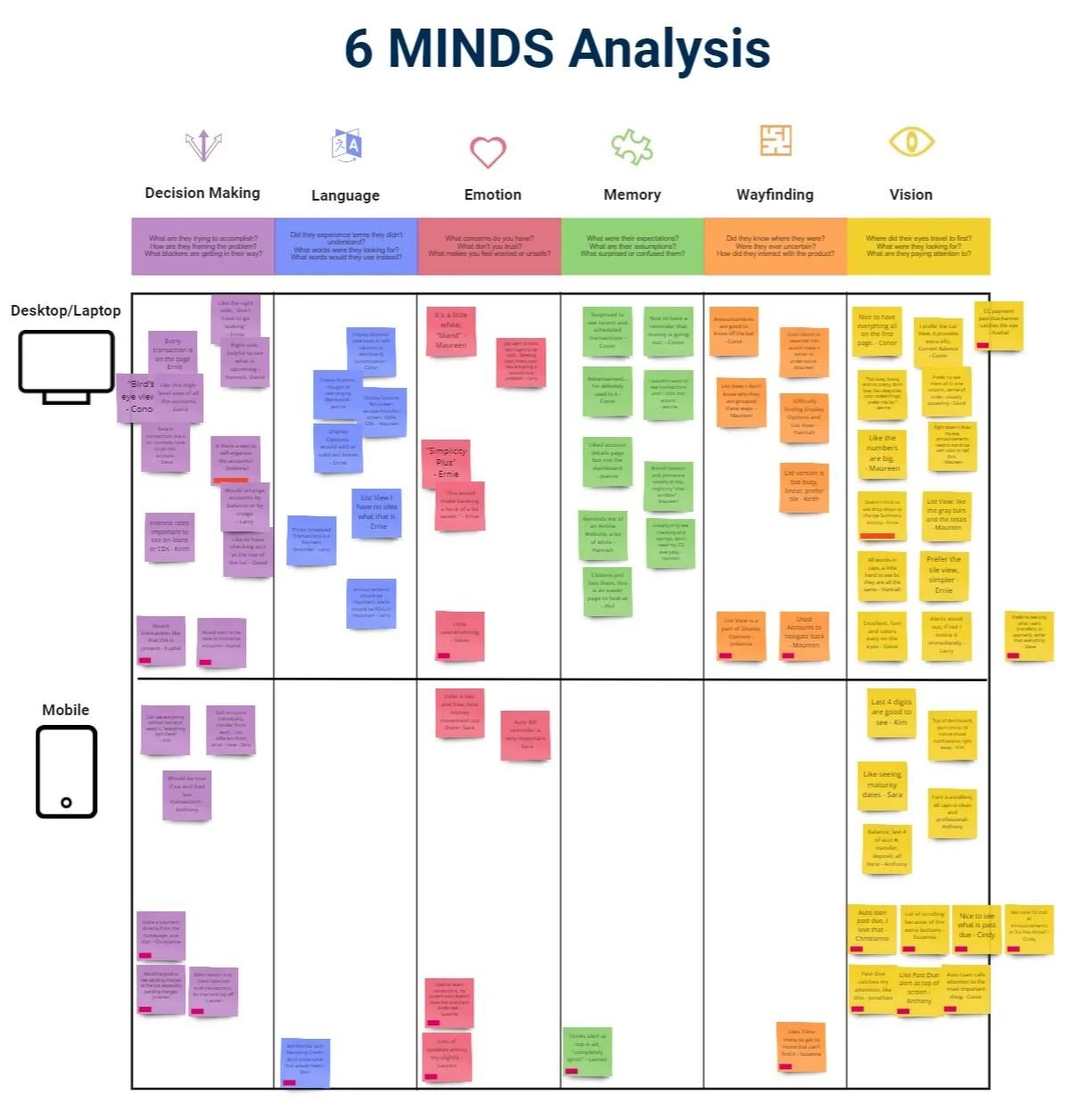
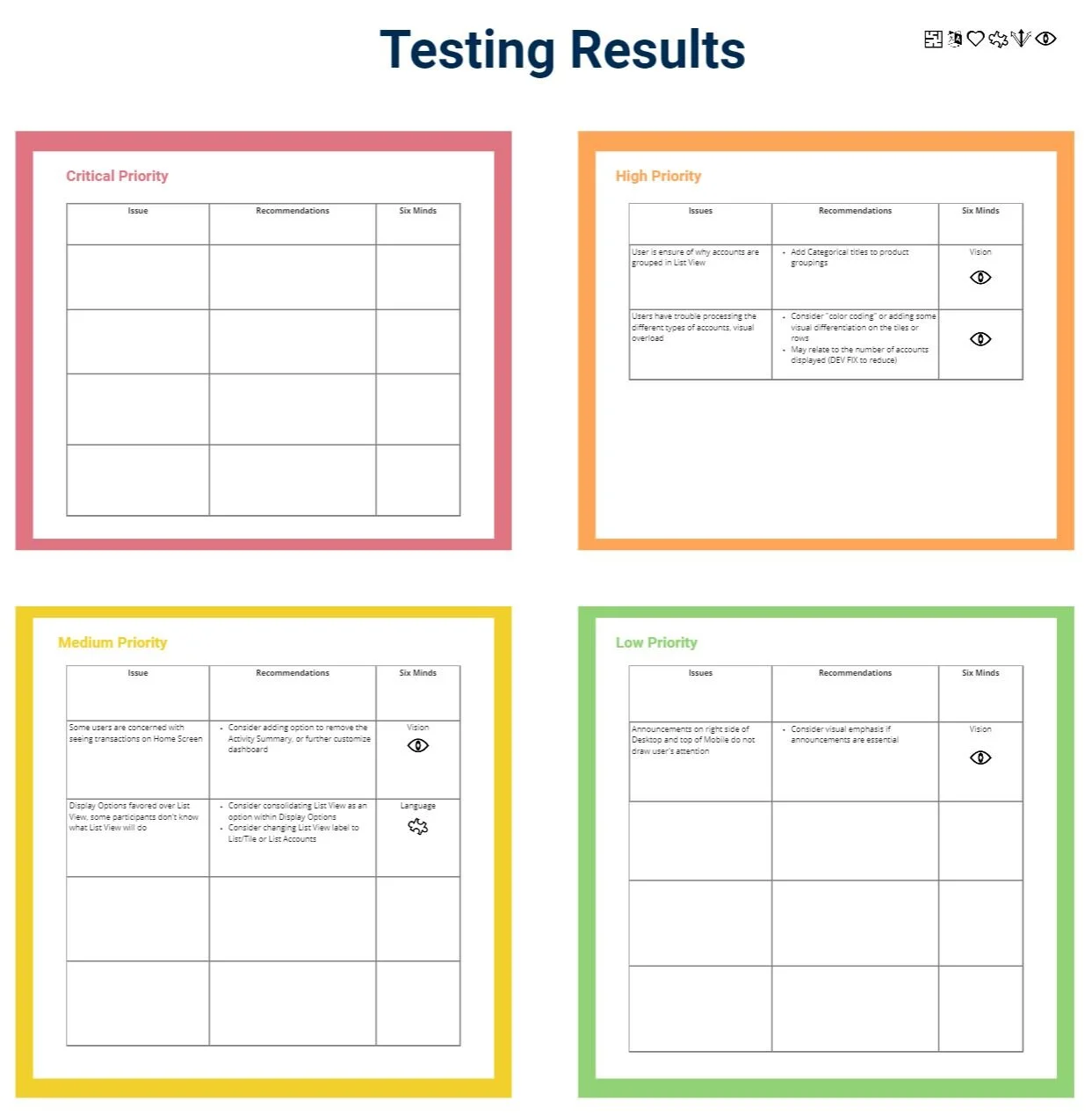
Our Testing Results diagnosed issues in terms of their psychological origins and recommended solutions appropriately.
Results and Reporting
At the conclusion of each sprint, I crafted a progress report to review and present our findings to the client.
My goal in research is to let the data speak for itself; in each progress report I included:
An overview of what we tested and why
Summary pain-points and prominent interactions
Corroborating data from the card sort, competitive research, or previous testing
Behavioral trends and stats
Prominent quotes or clips as evidence
I then presented the client with issues ranked by severity and options for next steps and opportunities for future testing.
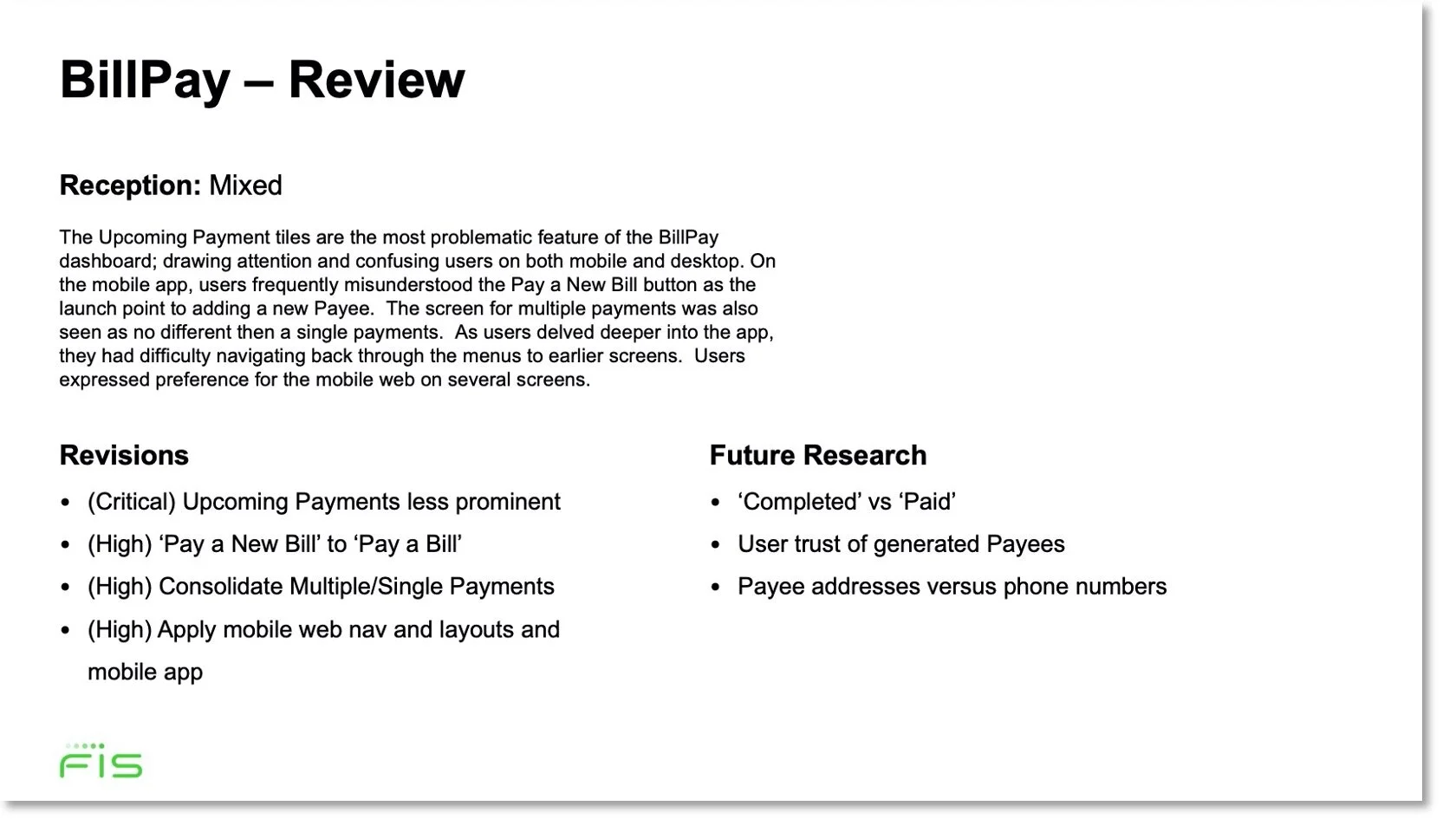
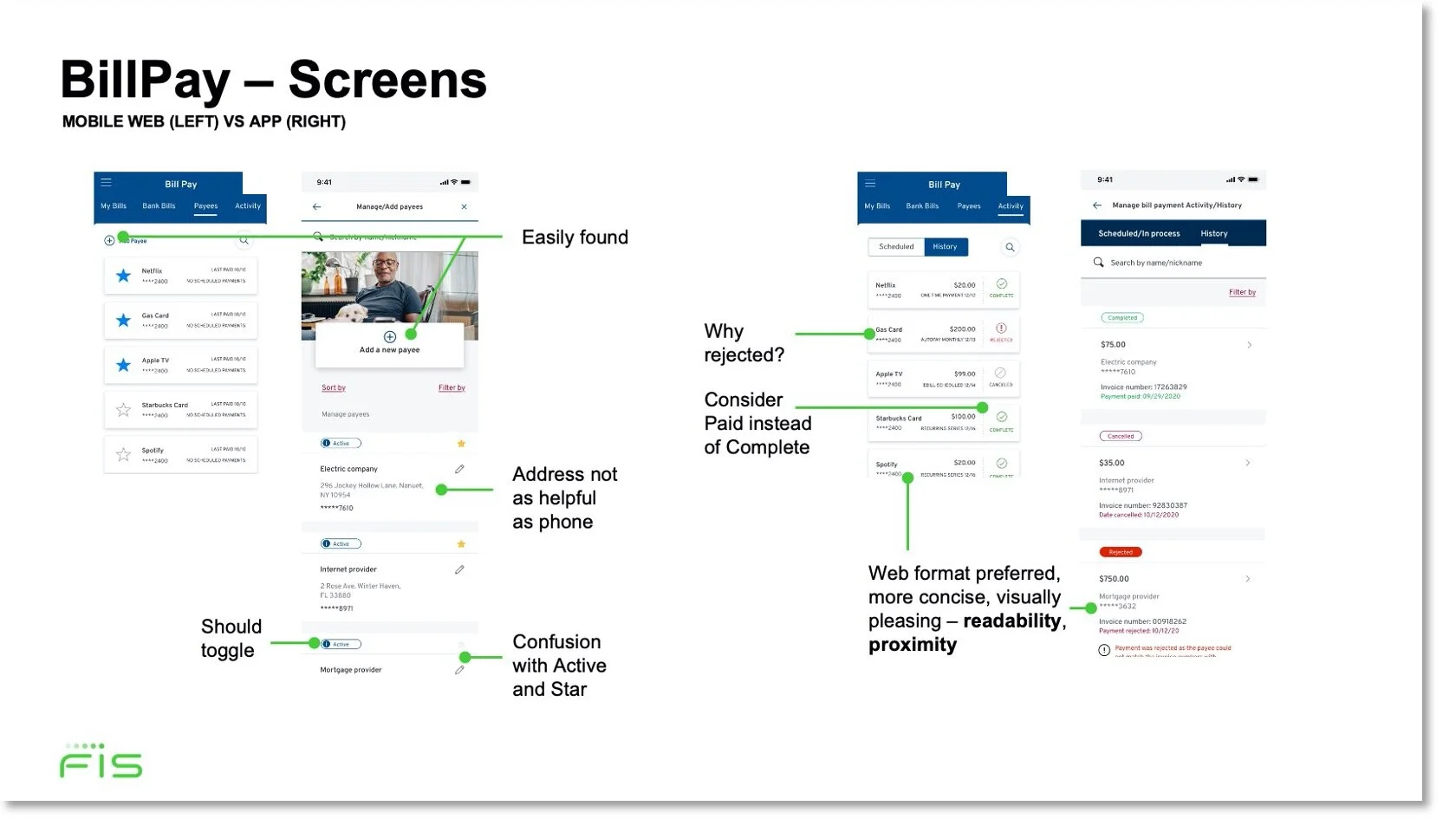
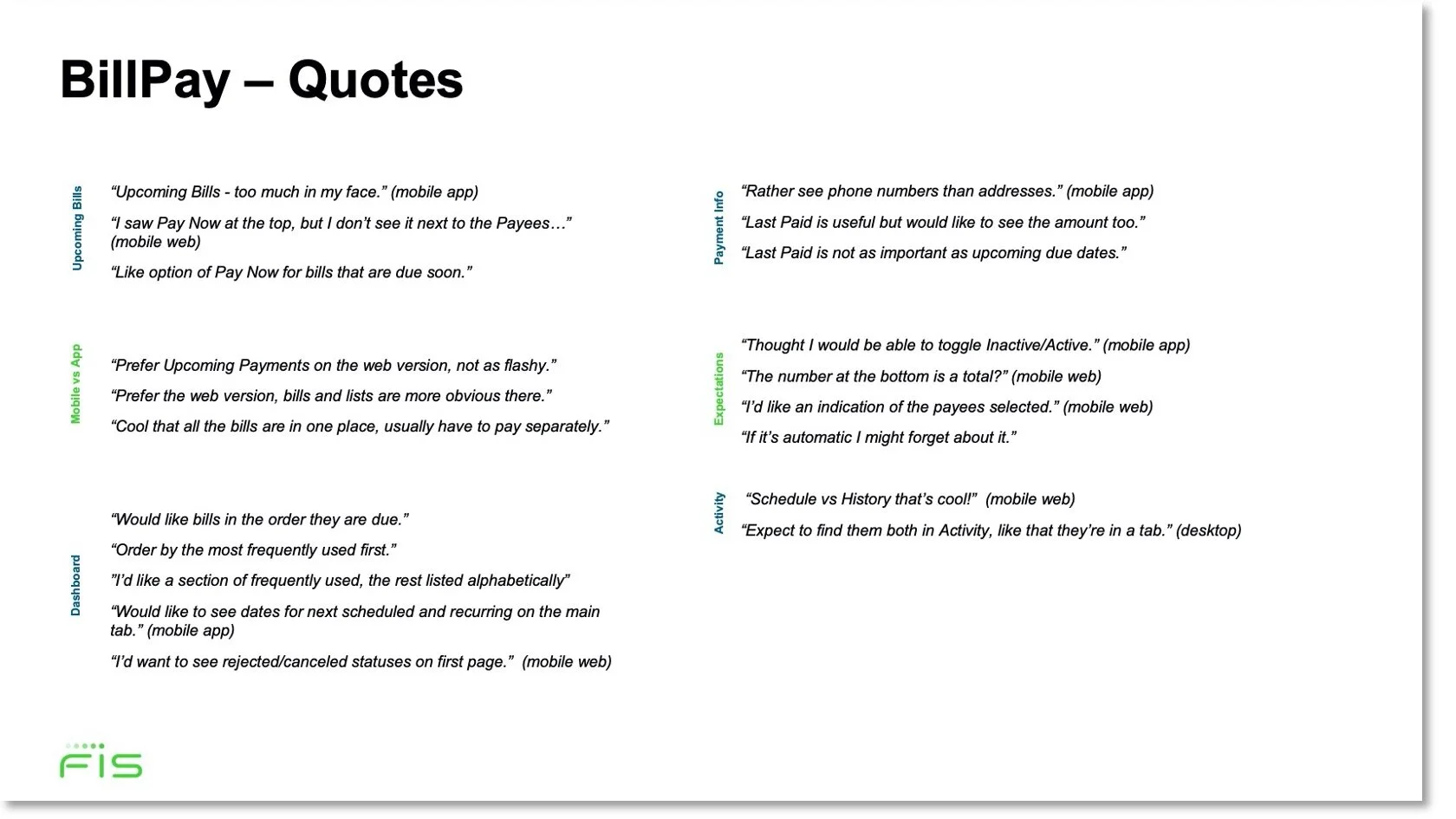
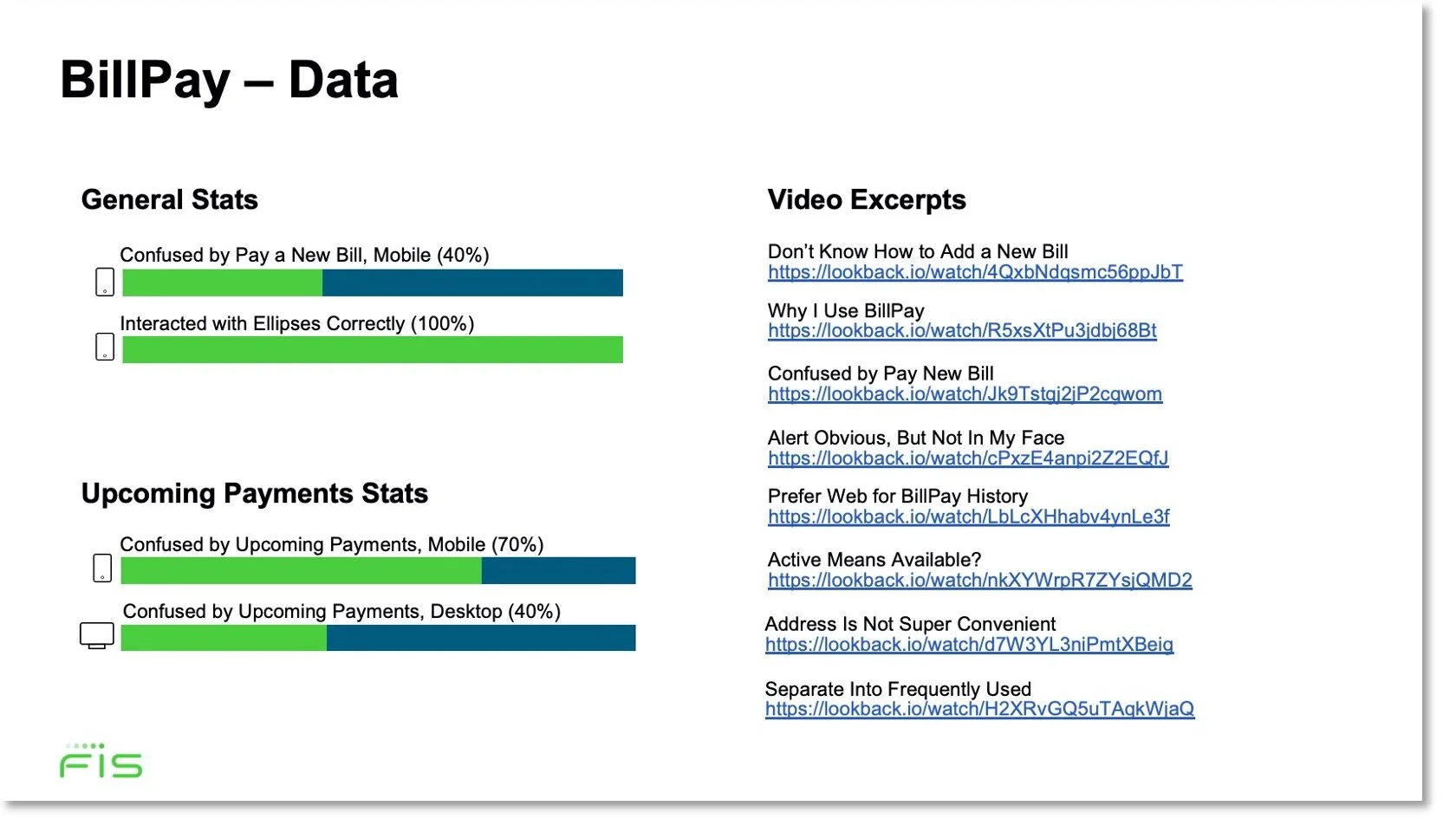
Excerpts from my progress report on BillPay. In BillPay and Transfers, users struggled with the navigation, readability, and visibility of the native app in comparison to the mobile web. This led to a hybridization of the two platforms to reduce code and optimize the experience.
Revisions and Iteration
As we tested, we revised our designs with input from product, development, and the client. The dashboard in particular underwent the most scrutiny as it was relevant to the user journeys with the most impact.
Our first iteration of the dashboard performed well, but did not surprise or delight in any positive way. The second iteration was more visually pleasing and efficient, but users felt the design lacked utility (the quick action buttons were removed for all accounts except the primary account). In the third iteration, we added personalization options to re-arrange accounts and add functionality — which was well-received but could be made more obvious.
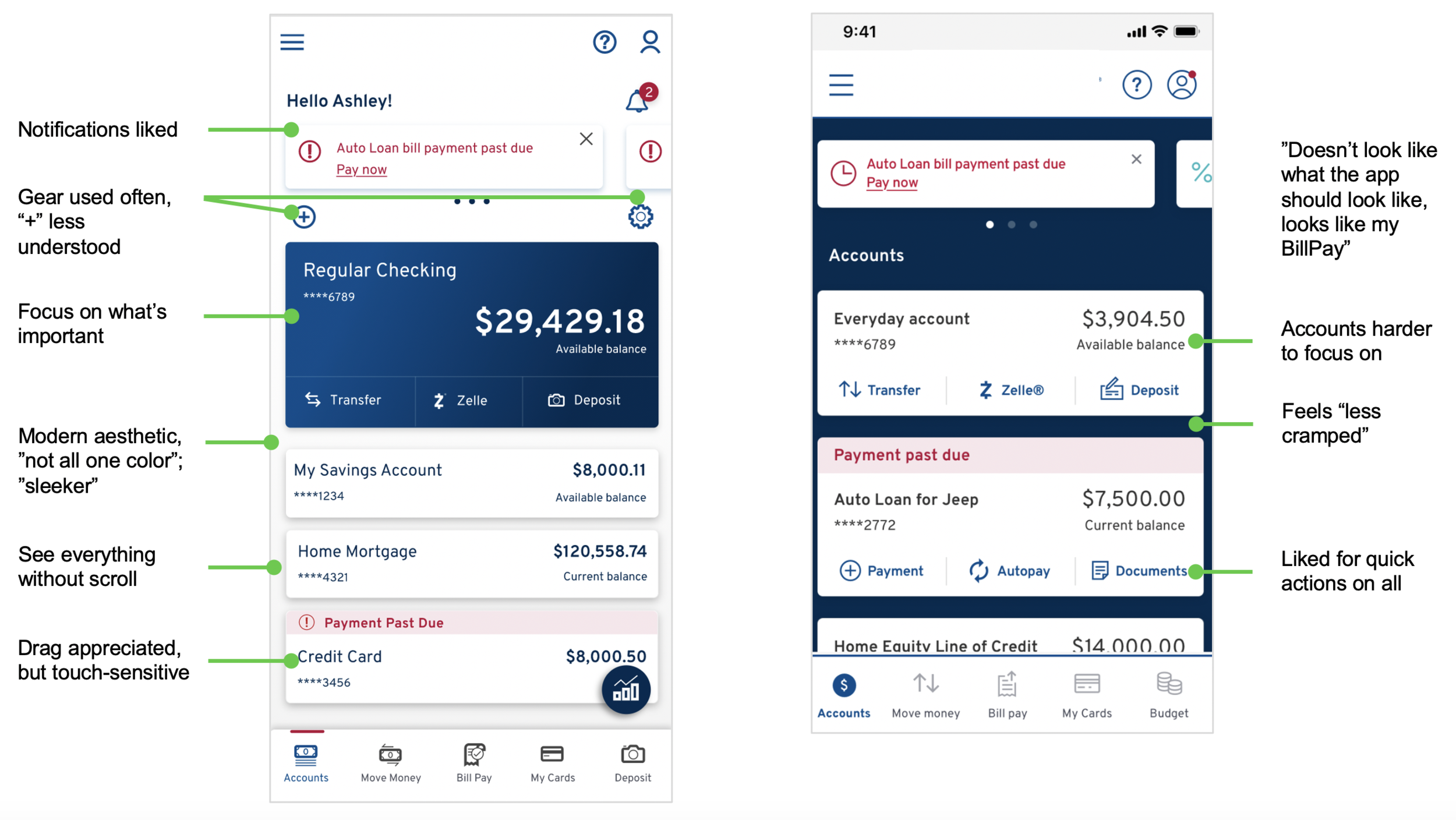
Dashboard 2nd Iteration (Left) and 1st Iteration (Right)
Sales Advocacy
After the testing was completed, I standardized a marketable process for in-sprint user testing - which our sales team then sold to existing and potential clients. I provided an overview and price estimates for them to share with current and prospective clients.
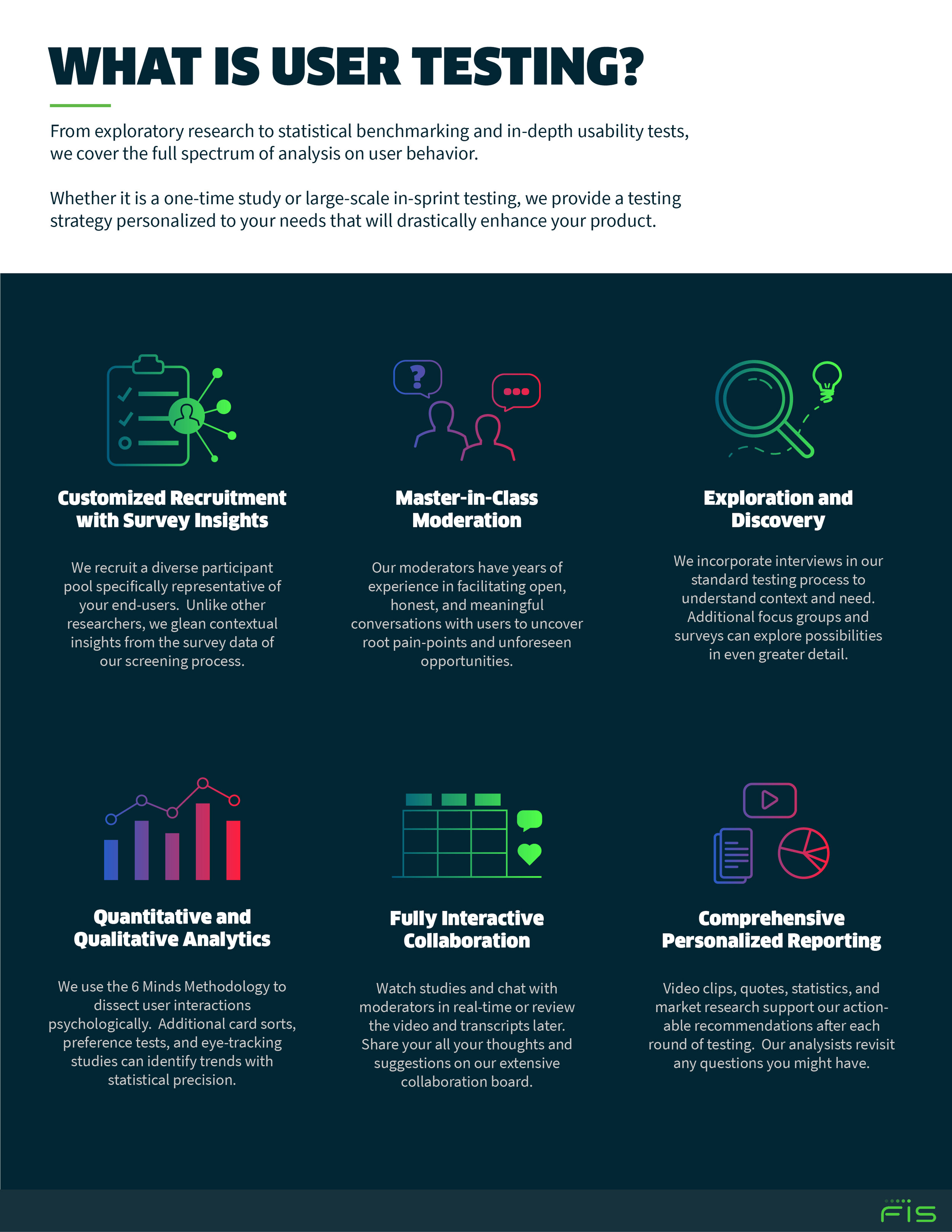
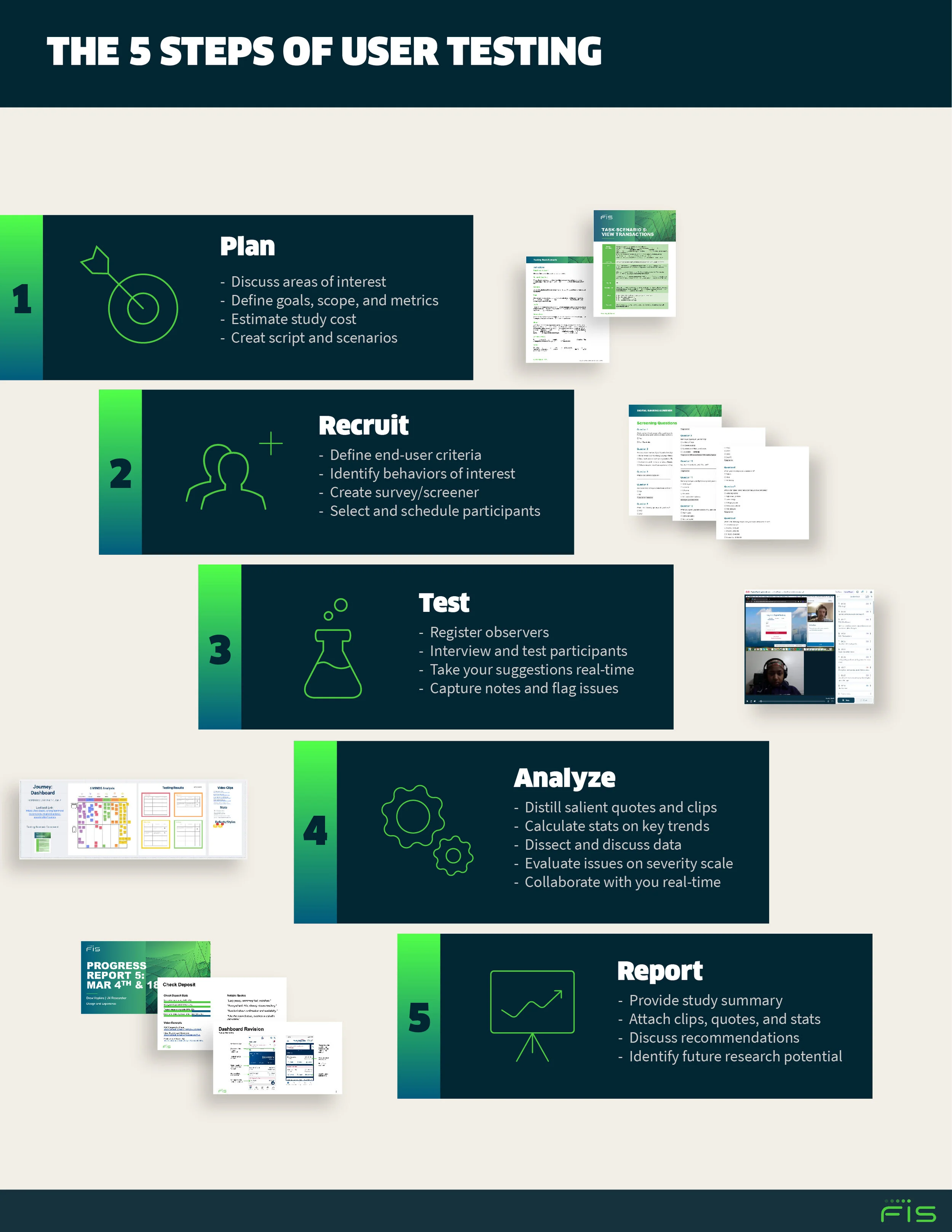
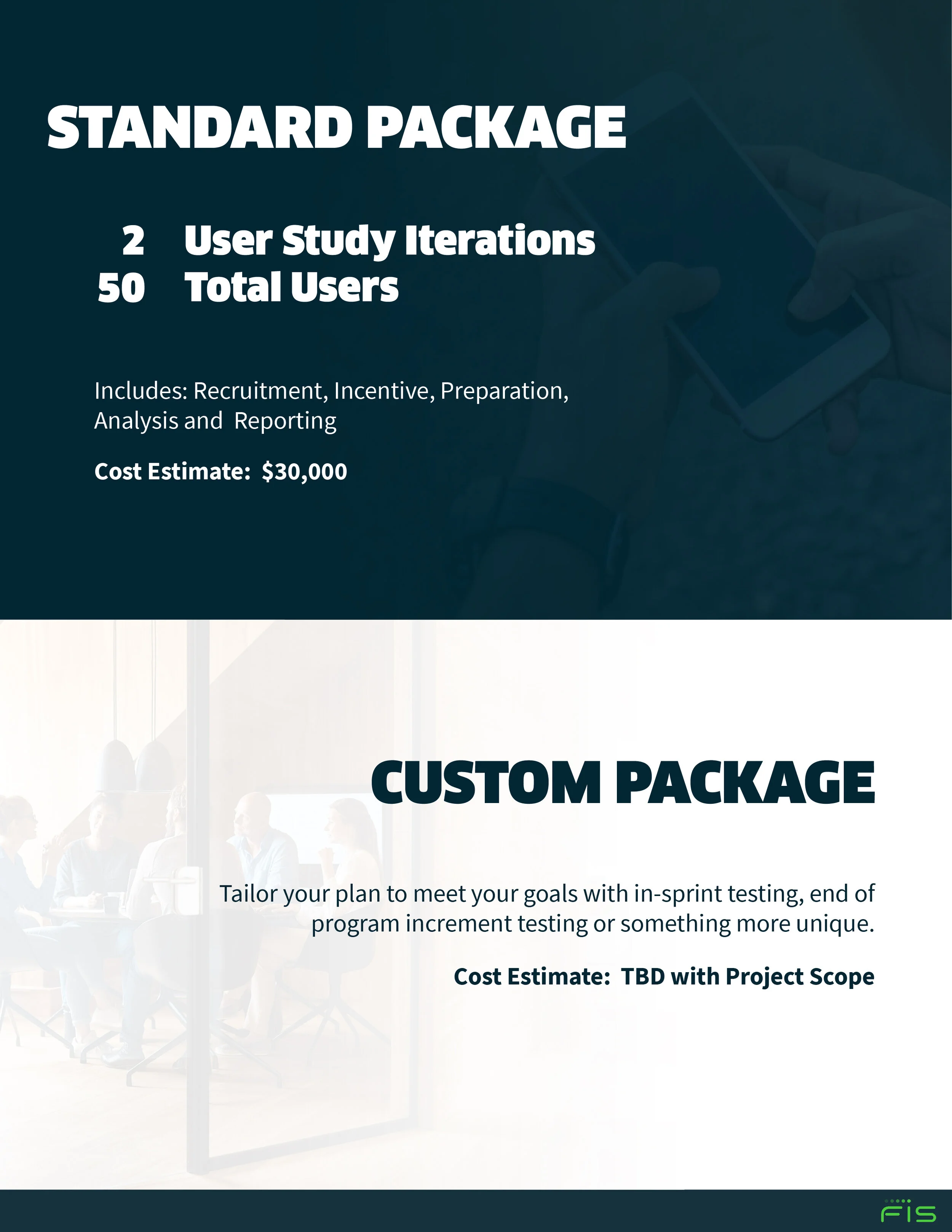
I created this sales document to explain and sell our testing process to future prospects.
Informing Future Research
Up until this point, our team had distinguished users primarily in terms of age. Generational membership (Gen Z, Millennials, etc.) was the key differentiator in understanding and evaluating trends in user interactions.
However, I came to realize through the surveys and testing that our users were better understood in terms of their financial goals and needs. Although goals and needs skewed with age, they were not defined by it. I categorized users into four personas and extracted the data from our studies to support them.
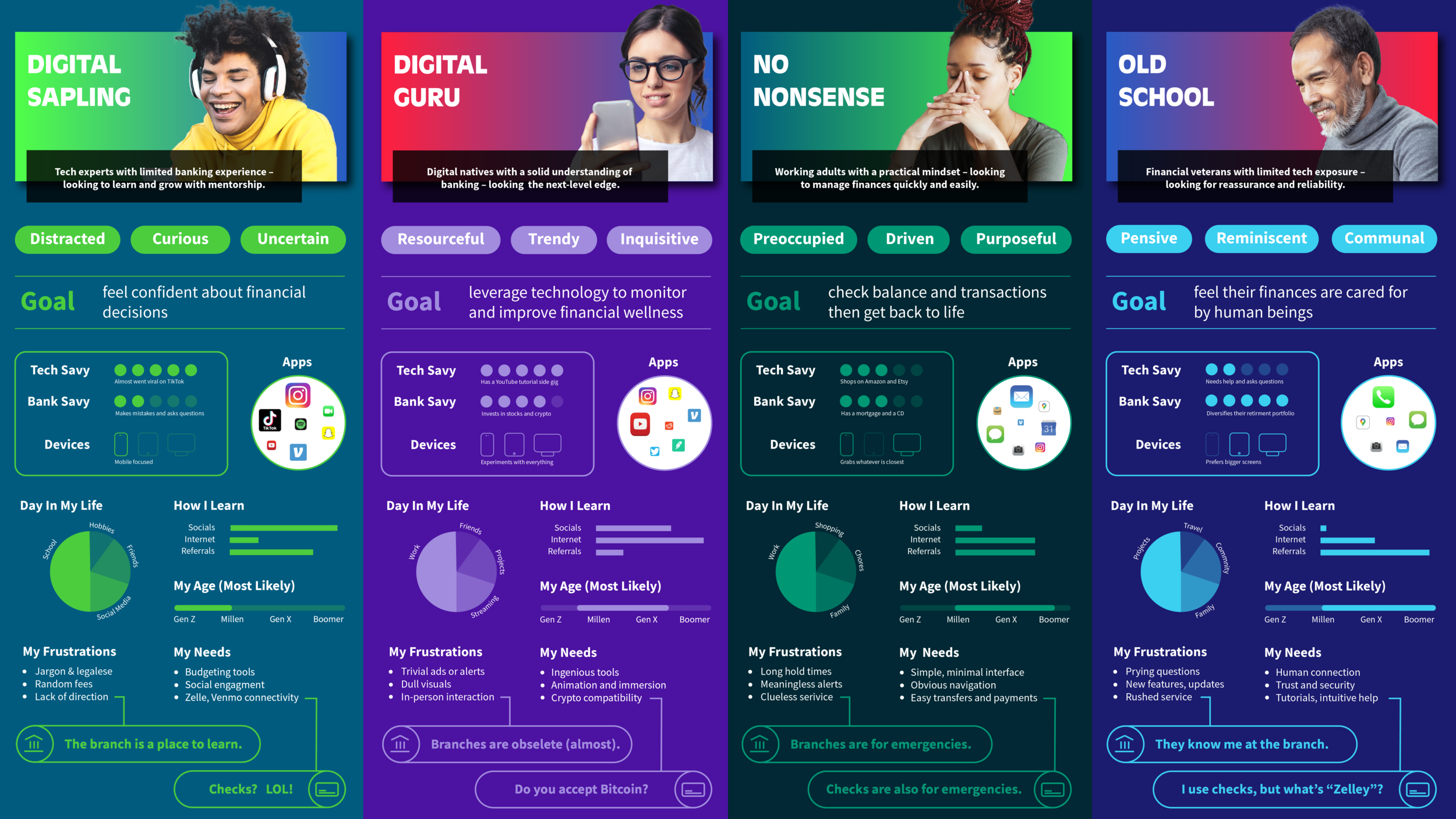
I created personas so our design team could better envision product requirements, while also showcasing user intimacy to our customers.
Impact
Launch of a data-backed next-gen redesign in onboarding and accounts servicing for one of FIS’s top-clients.
Gained a new web and mobile front-end for onboarding and account servicing to sell as upgrades to existing clients or as a new premium entry-point for new clients.
Created a marketable well-documented research process with reusable artifacts and templates to sell as product personalization for existing and future clients.
Reframed personas from generational segments to behavioral/financial goal-based segments, improving recruitment and testing precision in the future.
Lessons Learned
Iterate on strategy: like the product, our testing strategy continues to evolve. I continue to tweak the research boards and progress reports to better showcase our findings.
Trouble-shoot in advance: guiding participants through firewalls on to a remote environment was challenging, but by revising our onboarding documents and creating a trouble-shooting guide it became much more fluid.
Share frequently:in-sprint testing really tests a design team’s cohesion; we quickly learned that frequent sharing and daily meet-ups were a great way to keep collaboration at a high.